place

Brīvības iela

Streets in Riga
Brīvības iela panoramio (10)

Brīvības iela is the central street of Riga, the capital of Latvia. It is more than 12 km long, going through all of Riga from the historical centre to the outskirts.

Excerpt from the Wikipedia article Brīvības iela (License: CC BY-SA 3.0, Authors, Images).

Brīvības iela
Brīvības bulvāris, Riga Centre

Geographical coordinates (GPS) Address Nearby Places
placeShow on map

Wikipedia: Brīvības ielaContinue reading on Wikipedia

Geographical coordinates (GPS)

Latitude Longitude
N 56.951555555556 ° E 24.113222222222 °
placeShow on map

Address

Brīvības piemineklis

Brīvības bulvāris
LV-1050 Riga, Centre
Vidzeme, Latvia
mapOpen on Google Maps

Brīvības iela panoramio (10)
Share experience

Nearby Places

Freedom Monument
Freedom Monument

The Freedom Monument (Latvian: Brīvības piemineklis), is located in Riga, Latvia, honouring soldiers killed during the Latvian War of Independence (1918–1920). It is considered an important symbol of the freedom, independence, and sovereignty of Latvia. Unveiled in 1935, the 42-metre (138 ft) high monument of granite, travertine, and copper often serves as the focal point of public gatherings and official ceremonies in Riga. The sculptures and bas-reliefs of the monument, arranged in thirteen groups, depict Latvian culture and history. The core of the monument is composed of tetragonal shapes on top of each other, decreasing in size towards the top, completed by a 19-metre (62 ft) high travertine column bearing the copper figure of Liberty lifting three gilded stars. The concept for the monument first emerged in the early 1920s when the Latvian Prime Minister, Zigfrīds Anna Meierovics, ordered rules to be drawn up for a contest for designs of a "memorial column". After several contests the monument was finally built at the beginning of the 1930s according to the scheme "Mirdzi kā zvaigzne!" ("Shine like a star!") submitted by Latvian sculptor Kārlis Zāle. Construction works were financed by private donations. Following the Soviet occupation of Latvia in 1940, Latvia was annexed by the Soviet Union and the Freedom Monument was considered for demolition, but no such move was carried out. Soviet sculptor Vera Mukhina is sometimes credited for rescuing the monument, because she considered it to be of high artistic value. In 1963, when the issue of demolition was raised again, it was dismissed by Soviet authorities as the destruction of the monument would have caused deep indignation and tension in society. During the Soviet era, it remained a symbol of national independence to the general public. Indeed, on 14 June 1987, about 5,000 people gathered at the monument to lay flowers. This rally renewed the national independence movement, which culminated three years later in the re-establishment of Latvian sovereignty after the dissolution of the Soviet Union. The female figure at the top of the Freedom Monument is affectionately called Milda, because model for the sculpture was a Lithuanian woman Milda Jasikienė, who lived in Riga.

Riga State Gymnasium No.1

Riga State Gymnasium No.1 (Latvian: Rīgas Valsts 1. ģimnāzija), the oldest school in the Baltic states, offers secondary education (grades 7 to 12) in Riga, the capital of Latvia. The school traces its origins to school of Riga Cathedral, which was founded in 1211, a decade after the foundation of Riga itself. Its name and language of instruction have changed several times during its history. The school language was German from the school's foundation until 1892, when it became Russian. Latvian became the main language of instruction in 1919. Today, the gymnasium is known for its strong programs in the natural sciences, mathematics and computer science. Students wishing to enroll at the school take an admissions test in mathematics. Its admissions rate, with as many as nine candidates competing for each position, is one of the lowest in the country. Since 1997 the school enrolls 30 to 40 people in its International Baccalaureate Diploma Programme each year, where instruction is offered in English. It was the first school in the Baltic states to offer the IBO Diploma Programme. Each year a number of 12th grade students finish the DSD (Das Deutsches Sprachdiplom) programme by taking an exam along with the regular school leaving exams. Passing the exam enables them to pursue their higher education in German speaking countries. Riga State Gymnasium No.1 is consistently ranked first among the schools in Latvia. Its students' average results on school leaving (state) exams are the highest in the country. Riga State Gymnasium No.1 is also the best school in Latvia based on its students' achievements at various domestic and international academic competitions.Many of the graduates continue their education at highly ranked universities abroad, particularly in the UK, the Netherlands, Denmark, Germany, Austria, Switzerland and the USA. The percentage of these students is very high among the ones who graduate from the IBO Diploma Programme.

Latvian War Museum
Latvian War Museum

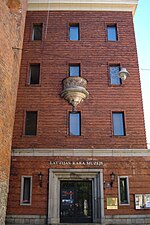
The Latvian War Museum (Latvian: Latvijas Kara muzejs) is a military museum in Riga, the capital of Latvia. The Latvian War Museum was established on 15 October 1916 as the Latvian Riflemen Battalion Museum. Initially the museum had its premises at Tērbatas Street 1/3. The museum collected material relating to the Latvian Riflemen and World War I. In 1917, when Riga was bombarded, the museum was evacuated. In June 1919 the museum restored operations at the Powder Tower in old town Riga. The museum opened to the public in June 1921. In 1936 the government acquired the neighbouring land lot. The erection of a new museum building was initiated in 1937, according to a project by architect Artūrs Galindoms. The interior works were additionally designed by architect R. Legzdiņš. All museum artifacts were temporarily stored at the museum workshop in Torņa Street. The new museum building was finished in the summer of 1940, but the museum did not manage to arrange *the exhibitions prior to the Soviet occupation of Latvia in 1940. The Latvian War Museum came under the jurisdiction of the Latvian People's Army's liquidation commission, which handed the museum artifacts over to the People's Commissariat of Education, and were stored at the previous Riga Stock Exchange building; and the museum premises were handed over to the Red Army. On 15 January 1941 the Latvian War Museum ceased to exist. Beginning in 1945, the building housed the Riga Nakhimov Naval School and continued to house it until 1953. From 1957 to 1990 the premises were occupied by the Latvian SSR Revolution Museum, which interpreted 20th century Latvian history through the point of view of Soviet ideology. However, the museum had during its existence gathered valuable, representative Soviet artifacts for its collections. On 11 June 1990 the Government of Latvia restored the Latvian War Museum.