place

Pierre Laporte Bridge

1970 establishments in QuebecBridges completed in 1970Bridges in Quebec CityBridges over the Saint Lawrence RiverBuildings and structures in Lévis, Quebec
Road bridges in QuebecSuspension bridges in CanadaTransport in Lévis, Quebec
LaPorte de Quebec (5802230245)

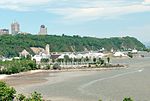
The Pierre Laporte Bridge (French: Pont Pierre-Laporte) is the longest main span suspension bridge in Canada. It crosses the Saint Lawrence River approximately 200 metres (660 ft) west (upstream) of the Quebec Bridge between Quebec City and Lévis, Quebec. It is the longest non-tolled suspension bridge in the world at 1,041 metres (3,415 ft).It was originally named the New Quebec Bridge (Nouveau pont de Québec) and was supposed to be called Pont Frontenac (Frontenac Bridge) until it was renamed in honour of Quebec Vice-Premier Pierre Laporte, who was kidnapped and murdered during the October Crisis of 1970 as construction of the bridge was nearing completion. The bridge was constructed for the Province of Quebec, Department of Roads in a joint venture with the private firm of Parsons Transportation Group. It carries Autoroute 73, north from Autoroute 20, the Trans-Canada Highway, to Quebec City and Autoroute 40, and northwards towards Saguenay.

Excerpt from the Wikipedia article Pierre Laporte Bridge (License: CC BY-SA 3.0, Authors, Images).

Pierre Laporte Bridge
Boulevard Champlain, Quebec Sillery (Sainte-Foy–Sillery–Cap-Rouge)

Geographical coordinates (GPS) Address External links Nearby Places
placeShow on map

Wikipedia: Pierre Laporte BridgeContinue reading on Wikipedia

Geographical coordinates (GPS)

Latitude Longitude
N 46.745 ° E -71.290833333333 °
placeShow on map

Address

Pont Pierre-Laporte

Boulevard Champlain
G1W 4S3 Quebec, Sillery (Sainte-Foy–Sillery–Cap-Rouge)
Quebec, Canada
mapOpen on Google Maps

linkWikiData (Q761692)
linkOpenStreetMap (974494218)

LaPorte de Quebec (5802230245)
Share experience

Nearby Places

Disappearance of Marilyn Bergeron

On the morning of February 17, 2008, Marilyn Bergeron (born December 21, 1983) left her family's home in Quebec City, Quebec, Canada, for what she said was a walk. She did not return. An automated teller machine (ATM) security camera in Loretteville recorded her attempting to withdraw money early in the afternoon; she was last seen almost five hours after leaving home at a coffee shop in Saint-Romuald. Many sightings of her have been reported since then, especially in areas of Ontario just outside Quebec, but none have been confirmed. Quebec City police (SPVQ), who continue to investigate, have theorized that Bergeron committed suicide. Her family, who has put up a reward for information leading to the resolution of the case, believes she may have instead met with foul play. Shortly before her disappearance she had moved back to Quebec City from Montreal, where she told her parents, without being specific, that something had happened there and she no longer felt safe living on her own.Due to this, and the jurisdictional limitations of the SPVQ, the family has repeatedly petitioned the provincial Ministry of Public Security to order the case file transferred to either the Montreal police or the Sûreté du Québec, both of whom they feel could make more progress; the request has been refused. As a result, they have retained former provincial justice minister Marc Bellemare to press their case. Crime journalist Claude Poirier has also devoted an episode of his Historia series Poirier Enquête to the case. In 2017, a friend who knew Bergeron in Montreal confirmed that she had grown increasingly fearful and reclusive there in the two months before her disappearance. He said he had asked her if she had been raped or witnessed a crime. She said what had happened to her was "worse" than that, but refused to elaborate.