place

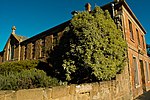
Holy Trinity Church, North Hobart

1849 establishments in Australia19th-century Anglican church buildingsAnglican churches in TasmaniaChurches in HobartGothic Revival architecture in Hobart
Gothic Revival church buildings in AustraliaGreek Orthodox churches in AustraliaNorth Hobart, TasmaniaUse Australian English from November 2016

Holy Trinity Church is a former Anglican, and now Greek Orthodox, church in North Hobart, Tasmania.Holy Trinity has the oldest peal of bells of its type outside England.The church was designed in the Gothic Revival style by James Blackburn and consecrated in 1849. Rev. Philip Palmer was its first rector.In February 2007, a property assessment report found that more than $5 million was needed to restore the church building, and that it was unrealistic for the parish to continue maintaining all its properties. The following month, the parish council petitioned the Bishop of Tasmania, Rt. Rev. John Harrower, to deconsecrate the building. In August the decision to close the church was communicated to the congregation, and the final service was held on 28 October 2007.The Holy Trinity Church Charitable Trust was formed in November 2007 in an effort to preserve the building. The Trust asked the Anglican Church to transfer the property to them, but it was instead sold to the Greek Orthodox Archdiocese of Australia. As of 2015, extensive repairs had started on the church.

Excerpt from the Wikipedia article Holy Trinity Church, North Hobart (License: CC BY-SA 3.0, Authors).

Holy Trinity Church, North Hobart
Church Street, Hobart Hobart

Geographical coordinates (GPS) Address Nearby Places
placeShow on map

Wikipedia: Holy Trinity Church, North HobartContinue reading on Wikipedia

Geographical coordinates (GPS)

Latitude Longitude
N -42.8767 ° E 147.3214 °
placeShow on map

Address

Church Street

Church Street
7000 Hobart, Hobart
Tasmania, Australia
mapOpen on Google Maps

Share experience

Nearby Places

Hobart
Hobart

Hobart ( (listen) HOH-bart; Nuennonne/Palawa kani: nipaluna) is the capital and most populous city of the Australian island state of Tasmania. Home to almost half of all Tasmanians, it is the least-populated Australian state capital city, and second-smallest if territories are taken into account, before Darwin, Northern Territory. Hobart is located in Tasmania's south-east on the estuary of the River Derwent, making it the most southern of Australia's capital cities. Its skyline is dominated by the 1,271-metre (4,170 ft) kunanyi/Mount Wellington, and its harbour forms the second-deepest natural port in the world, with much of the city's waterfront consisting of reclaimed land. The metropolitan area is often referred to as Greater Hobart, to differentiate it from the City of Hobart, one of the five local government areas that cover the city. It has a mild maritime climate. The city lies on country which was known by the local Mouheneener people as nipaluna, a name which includes surrounding features such as kunanyi/Mt. Wellington and timtumili minanya (River Derwent). Prior to British settlement, the land had been occupied for possibly as long as 35,000 years by the semi-nomadic Mouheneener people, a sub-group of the Nuennone, or "South-East tribe".Founded in 1804 as a British penal colony, Hobart is Australia's second-oldest capital city after Sydney, New South Wales. Whaling quickly emerged as a major industry in the area, and for a time Hobart served as the Southern Ocean's main whaling port. Penal transportation ended in the 1850s, after which the city experienced periods of growth and decline. The early 20th century saw an economic boom on the back of mining, agriculture and other primary industries, and the loss of men who served in the world wars was counteracted by an influx of immigration. Despite the rise in migration from Asia and other non-English speaking regions, Hobart's population remains predominantly ethnically Anglo-Celtic, and has the highest percentage of Australian-born residents among Australia's capital cities.Today, Hobart is the financial and administrative hub of Tasmania, serving as the home port for both Australian and French Antarctic operations and acting as a tourist destination, with over 1.192 million visitors in 2011–12. Well-known drawcards include its convict-era architecture, Salamanca Market and the Museum of Old and New Art (MONA), the Southern Hemisphere's largest private museum.