place

Hobart City Centre

Central business districts in AustraliaEconomy of HobartGeography of HobartLocalities of City of HobartSuburbs of Hobart
Use Australian English from August 2019
Hobart and Mount Wellington 20171120 039

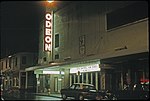
Hobart City Centre (referred to as Hobart CBD) is a suburb surrounded by metropolitan Hobart, which comprises the original settlement, the central business district, and other built-up areas. It is the oldest part of Hobart and includes many of the city's important institutions and landmarks, such as Parliament, the Supreme Court, Franklin Square, the Elizabeth Street Mall, the Royal Hobart Hospital, the Theatre Royal, Odeon Theatre, State Library, the NAB Building, the Museum, and the Cenotaph. The city centre is located in the local government areas of the City of Hobart. Although the city centre is one of the oldest and most developed areas of Hobart, demographically it is one of the less densely populated areas in the greater area of Hobart, due to its core being commercial. In an attempt to create a more vibrant city at night, the state government has been encouraging inner city residential development in recent years. The population of the city centre was 3,390 in 2021.

Excerpt from the Wikipedia article Hobart City Centre (License: CC BY-SA 3.0, Authors, Images).

Hobart City Centre
Elizabeth Street, Hobart Hobart

Geographical coordinates (GPS) Address Nearby Places
placeShow on map

Wikipedia: Hobart City CentreContinue reading on Wikipedia

Geographical coordinates (GPS)

Latitude Longitude
N -42.880555555556 ° E 147.325 °
placeShow on map

Address

Country Leather

Elizabeth Street
7000 Hobart, Hobart
Tasmania, Australia
mapOpen on Google Maps

Hobart and Mount Wellington 20171120 039
Share experience

Nearby Places

Hobart
Hobart

Hobart ( (listen) HOH-bart; Nuennonne/Palawa kani: nipaluna) is the capital and most populous city of the Australian island state of Tasmania. Home to almost half of all Tasmanians, it is the least-populated Australian state capital city, and second-smallest if territories are taken into account, before Darwin, Northern Territory. Hobart is located in Tasmania's south-east on the estuary of the River Derwent, making it the most southern of Australia's capital cities. Its skyline is dominated by the 1,271-metre (4,170 ft) kunanyi/Mount Wellington, and its harbour forms the second-deepest natural port in the world, with much of the city's waterfront consisting of reclaimed land. The metropolitan area is often referred to as Greater Hobart, to differentiate it from the City of Hobart, one of the five local government areas that cover the city. It has a mild maritime climate. The city lies on country which was known by the local Mouheneener people as nipaluna, a name which includes surrounding features such as kunanyi/Mt. Wellington and timtumili minanya (River Derwent). Prior to British settlement, the land had been occupied for possibly as long as 35,000 years by the semi-nomadic Mouheneener people, a sub-group of the Nuennone, or "South-East tribe".Founded in 1804 as a British penal colony, Hobart is Australia's second-oldest capital city after Sydney, New South Wales. Whaling quickly emerged as a major industry in the area, and for a time Hobart served as the Southern Ocean's main whaling port. Penal transportation ended in the 1850s, after which the city experienced periods of growth and decline. The early 20th century saw an economic boom on the back of mining, agriculture and other primary industries, and the loss of men who served in the world wars was counteracted by an influx of immigration. Despite the rise in migration from Asia and other non-English speaking regions, Hobart's population remains predominantly ethnically Anglo-Celtic, and has the highest percentage of Australian-born residents among Australia's capital cities.Today, Hobart is the financial and administrative hub of Tasmania, serving as the home port for both Australian and French Antarctic operations and acting as a tourist destination, with over 1.192 million visitors in 2011–12. Well-known drawcards include its convict-era architecture, Salamanca Market and the Museum of Old and New Art (MONA), the Southern Hemisphere's largest private museum.