place

Place D'Youville (Quebec)

Buildings and structures in Quebec CitySquares in Canada
Place D'Youville, Québec, Canada

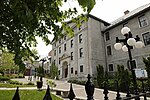
Place D’Youville, also referred to as carré D'Youville, is a public square in the core of Quebec City, Quebec, Canada. It is situated on rue Saint-Jean, one of the oldest roads in Quebec City. It marks the boundary between the Quebec Parliament Hill and Old Quebec. The square is named in honour of Marie-Marguerite d'Youville, a French Canadian widow who founded the religious order known as the Grey Nuns of Montreal.In addition to the square itself, Place D'Youville is also used to refer to the area surrounding the bus terminal for the Réseau de transport de la Capitale (Quebec City's transit system), the Palais Montcalm, and the Théâtre Capitole de Québec. Part of the square is transformed into a skating rink during winter months, and to its west is the sculpture "The Muses" by Alfred Laliberté, donated by the Government of Quebec for the 375th anniversary of the city in 1983.

Excerpt from the Wikipedia article Place D'Youville (Quebec) (License: CC BY-SA 3.0, Authors, Images).

Place D'Youville (Quebec)
Place d'Youville, Quebec

Geographical coordinates (GPS) Address Nearby Places
placeShow on map

Wikipedia: Place D'Youville (Quebec)Continue reading on Wikipedia

Geographical coordinates (GPS)

Latitude Longitude
N 46.812222 ° E -71.214167 °
placeShow on map

Address

Les muses

Place d'Youville
G1R 3P4 Quebec (La Cité-Limoilou)
Quebec, Canada
mapOpen on Google Maps

Place D'Youville, Québec, Canada
Share experience

Nearby Places

Le Diamant Theatre
Le Diamant Theatre

Le Diamant Theatre is a large-scale performing arts venue in the center of Québec City, Québec, Canada. Coarchitecture, In Situ, Jacques Plante Architects, OPI, Trizart Alliance, and Tetra Tech were chosen as the project's primary architects and structural designers to meet Quebec City's expanding needs for leisure, entertainment, and urban development. Le Diamant unifies traditional and modern architecture with the use of glass and asymmetrical design. The theater is located at the intersection of Rue des Glacis and Rue Saint-Jean, across from the historic square, Place D'Youville, in Quebec City's Saint-Roch neighborhood. Le Diamant Theatre was built over the course of three years by the Canadian construction company Pomerleau Inc., and it opened its doors in June 2019. Le Diamant Theatre was constructed for a total cost of $54 million, with an additional $10 million from the Quebec government, and the remaining money coming from private funding. New meeting rooms, offices, parking facilities, and a link between the upper and lower towns were all built as part of the project.Le Diamant Theatre's main auditorium has seating for up to 625 people. The theater holds several practice rooms, offices, and a café, as well as a smaller hall with seating for around 150 people. In addition, with the use of cutting-edge technology, such as sophisticated lighting and sound systems, a retractable orchestra pit, and a hydraulic stage, the building is created to host complex performances. Diamant Theatre's facade is covered by a large glass volume that glistens in the sunlight. The glass panels were designed to resemble diamond facets, hence the name "Le Diamant." A significant cultural icon in Quebec City, the theater has grown to become one of the main tourist destinations.

Ramparts of Quebec City

The ramparts of Quebec City is a city wall that surrounds the western end of Old Quebec's Upper Town in Quebec City, Quebec, Canada. The ramparts date back to the 17th century, with the ramparts having undergone a succession of modifications and improvements throughout its history. The city walls extends 4.6 kilometres (2.9 mi), with the southern portions of the ramparts forming a part of the Citadelle of Quebec. The ramparts were first built in 1690 in order to defend the Upper Town of Quebec City. In 1745, the walls were rebuilt further west, modelled after designs created by Gaspard-Joseph Chaussegros de Léry. The ramparts withstood several sieges during the mid-18th century, with British forces holding out in the walled city during the French siege of Quebec in 1760, and the American siege of Quebec in 1775. From the 1820s to 1830s, the British expanded and improved the ramparts and the rest of the city's defensive network. However, by the late-19th century, several deteriorating facilities associated with Quebec City's fortifications were demolished, although the primary defences remained. In 1948, the ramparts were designated as a part of the larger Fortifications of Québec National Historic Site. The fortifications, alongside the rest of Old Quebec, were designated as a UNESCO World Heritage Site in 1985; with the area serving as the only intact example of a fortified colonial settlement in North America north of Mexico.

Parliament Building (Quebec)

The Parliament Building of Quebec (French: Hôtel du Parlement du Québec) is an eight-floor structure and is home to the National Assembly of Quebec (French: Assemblée Nationale du Québec), located in Quebec City, Quebec, Canada. The Parliament Building was designed by architect Eugène-Étienne Taché in a Second Empire style and built between 1877 and 1886, in the heart of Quebec's Parliament Hill. The National Assembly (or, as it was called until 1968, the Legislative Assembly) first met there on March 27, 1884, even as the building was fully completed only two years later, on April 8, 1886. In 1910s-1930s, the government has built several adjacent buildings to expand its office spaces, creating a parliamentary complex, of which the Parliament Building is the main edifice. The government office, is a successor of several earlier buildings, the earliest of which was built in 1620 and among which there were two other parliament houses that served as legislatures from 1791. Geographically, the building is located in the Place de l'Assemblée-Nationale, in the district of Vieux-Québec–Cap-Blanc–colline Parlementaire, part of the borough of La Cité-Limoilou, just outside the walls of Old Quebec. However, the Parliament Building, along with several adjacent buildings and terrain, have been declared a "national historic site" (French: site historique national), and as such taken away from the control of the provincial Ministry of Culture and Communications and municipalities. This designation notwithstanding, the province of Quebec is signatory to a long-term leasing deal (called emphyteusis) when it comes to the territory in front of the National Assembly, that is, from the front entrance to the fortifications of the old town, as this parcel has belonged to the federal government since 1881.