place

Dannenstern House

1696 establishments in EuropeBaroque architecture in LatviaBuildings and structures in RigaHouses completed in 1696
Dannenstern House (2)

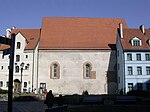
The Dannenstern House (Latvian: Dannenšterna nams) is a historical building in the Old town of Riga, Latvia. The house was built by and is named after Ernst Metsue von Dannenstern, a wealthy merchant. It dates from 1696 and is considered one of the finest examples of Baroque architecture in Riga. It was designed by German architect and chief architect of Riga Rupert Bindenschu. The street facade, in limestone, has giant order Corinthian pilasters and two elaborate entrance portals, created by sculptor D. Walter. The building also contains fragments of an earlier, medieval building.

Excerpt from the Wikipedia article Dannenstern House (License: CC BY-SA 3.0, Authors, Images).

Dannenstern House
Mārstaļu iela, Riga Old Riga

Geographical coordinates (GPS) Address External links Nearby Places
placeShow on map

Wikipedia: Dannenstern HouseContinue reading on Wikipedia

Geographical coordinates (GPS)

Latitude Longitude
N 56.945555555556 ° E 24.108055555556 °
placeShow on map

Address

Dannenšterna nams

Mārstaļu iela 21
LV-1050 Riga, Old Riga
Vidzeme, Latvia
mapOpen on Google Maps

linkWikiData (Q1164435)
linkOpenStreetMap (157821186)

Dannenstern House (2)
Share experience

Nearby Places

House of the Blackheads (Riga)

The House of the Blackheads (Latvian: Melngalvju nams, German: Schwarzhäupterhaus) is a building situated in the old town of Riga, Latvia. The original building was erected during the first third of the 14th century for the Brotherhood of Blackheads, a guild for unmarried merchants, shipowners, and foreigners in Riga. Major works were done in the early 17th century, adding most of the Mannerist ornamentation. The sculptures were made by the workshop of August Volz. Additionally, it is the site of the first decorated Christmas tree, which was erected in 1510. The building was bombed to a ruin by the Germans on June 28, 1941 — a week after the launching of Operation Barbarossa — and the remains were demolished by the Soviets in 1948. It was rebuilt between 1996 and 1999 with funds provided by Valērijs Kargins, the president of Parex Bank. Part of the funds donated were from all the people who wanted to participate in the rebuilding process, by joining in the event ''I build the House of the Black Heads'', where by donating 5 lats (approximately 7-11 EUR) they could symbolically put a brick on the wall. There were more than 5,000 participants. The House of the Black Heads was officially opened on December 9, 1999. Today the House of the Blackheads is a museum. In the upper level are located grand ballrooms, where historically many luxurious events happened — welcoming ceremonies for kings, queens, presidents, and also many cultural events — balls, classical music concerts, theatre performances, and operas with many world famous guest-stars. On another floor it is possible to visit the historic cabinets — a temporary work-space for the President of Latvia, who moved the Presidential residence to the House of the Blackheads from 2012 to 2016, while the permanent location in Riga Castle was under reconstruction. The historical cellar is the only original part of the building which survived World War II and during the Soviet Occupation. Until the early 1990s it was buried underground and not visible. The historic cellar is one of the few places where it is possible to walk through an authentic underground of Old Riga, where the remains — wall fragments, floor and even the wooden stairs are original, and some of that is dated as far back as the 14th century. This was former storage for goods and part of it was space for a hypocaust or warm air furnace. Today there are interesting, interactive exhibitions relating to commerce in Riga and the history of the Brotherhood of Blackheads.

1998 Riga bombing

The 1998 Riga bombings were a series of bombings that took place in Riga, Latvia and which received considerable coverage at the time, most notably for their connection with fascist groups and the perception of an increase of fascism in Latvia. The United States government offered to help to locate the suspects, calling the acts "cowardly," and then-Latvian Prime Minister Guntars Krasts condemned the bombings, calling them an attempt to destabilize the country.At 1:50 am on April 2 a bomb exploded in Riga's old town outside the 92-year-old Peitav Synagogue, the only surviving working synagogue in the city, causing severe damage to the building and surrounding area. The bomb, which was supposedly planted by fascist extremists, was reportedly placed on the front steps of the synagogue building. The bomb caused extensive damage, including tearing out the 90 kg oak door, destroying all the windows and casings of the basement and first and second floors, and leaving deep gouges in the wall. There were no casualties. Four days after the April 2 bombing, another explosion caused damage to the Russian Embassy in Riga. As with the April 2 explosion, there were no injuries. The cause of the blast was plastic explosives detonated in a trash bin. The attack was linked with a rise in nationalist and extremist actions that seriously unsettled relations among Latvians, Jews and Russians. Alexander Udaltsev, Russia's ambassador to Latvia, joined Latvian leaders in blaming the incident on those trying to drive a wedge between Russians and Latvians. The Russian Foreign Ministry controversially blamed the bombing outside its Riga embassy on "anti-Russian hysteria recently produced in Latvia and the encouragement of nationalism and extremism" and called for drastic measures to punish those who were guilty. A few days after the Riga bombings, a monument to Latvian victims of the Holocaust was defaced in the port town of Liepāja.