place

Holy Cross Cathedral, Lagos

1881 establishments in Lagos Colony20th-century Roman Catholic church buildings in NigeriaAfro-Brazilian architectureBuildings and structures in LagosChurches in Lagos
EngvarB from July 2017Gothic Architecture in LagosRoman Catholic cathedrals in NigeriaRoman Catholic churches completed in 1939
Holy Cross Cathedral Lagos

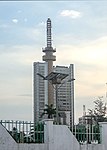
Holy Cross Cathedral is a Roman Catholic cathedral located in Lagos, Nigeria, and is the seat of the Archdiocese of Lagos. The Gothic style building was constructed in 1939, when the region was still administered as an apostolic vicariate, and thus was only elevated to the status of cathedral in 1950.

Excerpt from the Wikipedia article Holy Cross Cathedral, Lagos (License: CC BY-SA 3.0, Authors, Images).

Holy Cross Cathedral, Lagos
Campbell Street, Lagos

Geographical coordinates (GPS) Address External links Nearby Places
placeShow on map

Wikipedia: Holy Cross Cathedral, LagosContinue reading on Wikipedia

Geographical coordinates (GPS)

Latitude Longitude
N 6.4499 ° E 3.3966 °
placeShow on map

Address

Holy Cross Cathedral

Campbell Street
100242 Lagos
Lagos State, Nigeria
mapOpen on Google Maps

linkWikiData (Q22340604)
linkOpenStreetMap (381370025)

Holy Cross Cathedral Lagos
Share experience

Nearby Places

Southern Nigeria Protectorate

Southern Nigeria was a British protectorate in the coastal areas of modern-day Nigeria formed in 1900 from the union of the Niger Coast Protectorate with territories chartered by the Royal Niger Company below Lokoja on the Niger River.The Lagos colony was later added in 1906, and the territory was officially renamed the Colony and Protectorate of Southern Nigeria. In 1914, Southern Nigeria was joined with Northern Nigeria Protectorate to form the single colony of Nigeria. The unification was done for economic reasons rather than political—Northern Nigeria Protectorate had a budget deficit; and the colonial administration sought to use the budget surpluses in Southern Nigeria to offset this deficit.Sir Frederick Lugard, who took office as governor of both protectorates in 1912, was responsible for overseeing the unification, and he became the first governor of the newly united territory. Lugard established several central institutions to anchor the evolving unified structure. A Central Secretariat was instituted at Lagos, which was the seat of government, and the Nigerian Council (later the Legislative Council), was founded to provide a forum for representatives drawn from the provinces. Certain services were integrated across the Northern and Southern Provinces because of their national significance—military, treasury, audit, posts and telegraphs, railways, survey, medical services, judicial and legal departments—and brought under the control of the Central Secretariat in Lagos.The process of unification was undermined by the persistence of different regional perspectives on governance between the Northern and Southern Provinces, and by Nigerian nationalists in Lagos. While southern colonial administrators welcomed amalgamation as an opportunity for imperial expansion, their counterparts in the Northern Province believed that it was injurious to the interests of the areas they administered because of their relative backwardness and that it was their duty to resist the advance of southern influences and culture into the north. Southerners, on their part, were not eager to embrace the extension of legislation originally meant for the north to the south.