place

Freedom Park (Lagos)

2010 establishments in NigeriaEngvarB from August 2017Historic buildings and structures in NigeriaHistory of LagosLagos Island
Landmarks in LagosMonuments and memorials in LagosMuseums in LagosParks in LagosParks in NigeriaPrisons in NigeriaProtected areas established in 2010Protected areas of Lagos
Images of Freedom Park 63

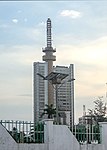
Freedom Park is a memorial and leisure park area in the middle of downtown Lagos in Lagos Island, Nigeria which was formerly Her Majesty's Broad Street Prison. It was designed by the Architect Theo Lawson. The Park was constructed to preserve the history and cultural heritage of Nigerians. Monuments in the park reveal the Lagos colonial heritage and history of Her Majesty's Broad Street prisons. It was built to commemorate the 50th anniversary independence celebration in October, 2010. The Park serves as a National Memorial, a Historical landmark, a Cultural site, Arts and Recreation centre. The park, when it was a prison hosted some political activists who fought for Nigeria's independence.The park, which is now a serene abode for individuals, visitors' collective contemplation and interaction is open to the public every day. Today, freedom park has become a venue for diverse social events and recreational entertainment.

Excerpt from the Wikipedia article Freedom Park (Lagos) (License: CC BY-SA 3.0, Authors, Images).

Freedom Park (Lagos)
Lagos

Geographical coordinates (GPS) Address Nearby Places
placeShow on map

Wikipedia: Freedom Park (Lagos)Continue reading on Wikipedia

Geographical coordinates (GPS)

Latitude Longitude
N 6.4489 ° E 3.3965 °
placeShow on map

Address


100242 Lagos
Lagos State, Nigeria
mapOpen on Google Maps

Images of Freedom Park 63
Share experience

Nearby Places

Southern Nigeria Protectorate

Southern Nigeria was a British protectorate in the coastal areas of modern-day Nigeria formed in 1900 from the union of the Niger Coast Protectorate with territories chartered by the Royal Niger Company below Lokoja on the Niger River.The Lagos colony was later added in 1906, and the territory was officially renamed the Colony and Protectorate of Southern Nigeria. In 1914, Southern Nigeria was joined with Northern Nigeria Protectorate to form the single colony of Nigeria. The unification was done for economic reasons rather than political—Northern Nigeria Protectorate had a budget deficit; and the colonial administration sought to use the budget surpluses in Southern Nigeria to offset this deficit.Sir Frederick Lugard, who took office as governor of both protectorates in 1912, was responsible for overseeing the unification, and he became the first governor of the newly united territory. Lugard established several central institutions to anchor the evolving unified structure. A Central Secretariat was instituted at Lagos, which was the seat of government, and the Nigerian Council (later the Legislative Council), was founded to provide a forum for representatives drawn from the provinces. Certain services were integrated across the Northern and Southern Provinces because of their national significance—military, treasury, audit, posts and telegraphs, railways, survey, medical services, judicial and legal departments—and brought under the control of the Central Secretariat in Lagos.The process of unification was undermined by the persistence of different regional perspectives on governance between the Northern and Southern Provinces, and by Nigerian nationalists in Lagos. While southern colonial administrators welcomed amalgamation as an opportunity for imperial expansion, their counterparts in the Northern Province believed that it was injurious to the interests of the areas they administered because of their relative backwardness and that it was their duty to resist the advance of southern influences and culture into the north. Southerners, on their part, were not eager to embrace the extension of legislation originally meant for the north to the south.