place

Volgogradsky Prospekt (Moscow Metro)

Moscow Metro stationsMoscow Metro stubsRailway stations in Russia opened in 1966Railway stations located underground in RussiaRussian railway station stubs
Tagansko-Krasnopresnenskaya Line
Volgogradsky mm
Volgogradsky mm

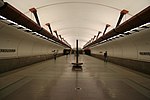
Volgogradsky Prospekt (Russian: Волгоградский проспект) is a Moscow Metro station in the Nizhegorodsky District, South-Eastern Administrative Okrug, Moscow. It is on the Tagansko-Krasnopresnenskaya Line, between Proletarskaya and Kuzminki stations. Volgogradsky Prospekt was opened on 31 December 1966 as part of the Zhadovsky radius and is named after the nearby Avenue that leads on from the centre of Moscow into an intercity highway all the way to the southwest of Russia, although not directly to Volgograd. The station was built to a slight modification of the standard 1960s pillar-trispan decoration showing the first signs of innovative design, as architects V. Polikarpova and A. Marova did. The platform is narrowed (as the station was never designed to carry large passenger crowds). The white ceramic tiles on the walls are arranged on 45 degrees to the platform and are decorated with metallic artworks out of anodized aluminium depicting the Battle of Stalingrad (artist E. Ladygin). The pillars are faced with white marble whilst the floor with grey granite. The station has two underground vestibules with glazed concrete pavilions which allow passengers access to the Talalikhin and Novostapovskaya streets as well as directly to the AZLK automobile plant..

Excerpt from the Wikipedia article Volgogradsky Prospekt (Moscow Metro) (License: CC BY-SA 3.0, Authors, Images).

Volgogradsky Prospekt (Moscow Metro)
Волгоградский проспект, Moscow Yuzhnoportovy District

Geographical coordinates (GPS) Address Nearby Places
placeShow on map

Wikipedia: Volgogradsky Prospekt (Moscow Metro)Continue reading on Wikipedia

Geographical coordinates (GPS)

Latitude Longitude
N 55.7253 ° E 37.6869 °
placeShow on map

Address

Волгоградский проспект

Волгоградский проспект
115088 Moscow, Yuzhnoportovy District
Moscow, Russia
mapOpen on Google Maps

Volgogradsky mm
Volgogradsky mm
Share experience

Nearby Places

Dubrovka (Lyublinsko-Dmitrovskaya line)

Dubrovka (Russian: Дубровка) is a station on the Moscow Metro's Lyublinsko–Dmitrovskaya line. Originally the station was to open along with the first stage of the Lyublinsky radius in 1995. However, it could not be opened because of problems with building an escalator tunnel in tough hydrological conditions. However, as the station is in the middle of an industrial zone, due to the economic difficulties of the late 1990s that hit Russia, most of these recently privatised industries were very short of finances and their production output was likewise stalled. This was enough to prevent additional heating of the frozen earth and finally on 11 December 1999 the Moscow's mayor Yury Luzhkov opened the station. The station in its design is identical to its neighbour Krestyanskaya Zastava where both are wall-columned with no underplatform service spaces. With no solid theme, the station (work of architects Ye.Barsky, V.Fillipov and S.Belyakova) is decorated with bright monochromatic marble on the columns and walls. The floor is covered in red and black granite. The station is decorated by a bright mosaic in the end of the central hall (artist Zurab Tsereteli). The vestibule of the station is interlinked with a subway network under the Sharikopodshipnikovskaya street, with modern glazed metal and concrete pavilions. The average passenger traffic is 14,400 people per day. Behind the station there is a piston junction used for emergency reversals of trains.

Modern University for the Humanities

The Modern University for the Humanities (MUH) (Russian: Современная гуманитарная академия), established in 1992. The university has been deprived of license order No.179-07 of January 30, 2017, accreditation cancelled April 26, 2015. This higher educational institution in Moscow, Russia offers primarily distance-based undergraduate, graduate, and post-graduate studies and vocational education. General management of MUH is performed from its Moscow headquarters. Currently, there are 628 educational centers established within the framework of MUH to support the dissemination of distance learning and correspondence material. These centers are located in the Russian Federation and CIS countries including Armenia, Belarus, Kazakhstan, Kyrgyzstan, Moldova, Ukraine, Georgia, Azerbaijan, and Tajikistan. MUH also has educational centers outside the former Soviet world, in Vietnam, Israel, China, Peru, and the Czech Republic. Particular attention is focused on extending the geographic coverage of MUH, especially on development in foreign countries. The university currently claimed an enrollment of more than 200,000 (2008) students.MUH is the only Russian higher educational institution possessing satellite educational technology. This allows the university the opportunity to provide distance learning resources to every geographic destination in the Russian Federation and in a number of Asian and European countries. MUH possesses satellite educational television with its own teleport for twenty-four-hour, four-channel broadcasting throughout the territory of Russia and the CIS countries. These four channels are also used for data transmission. It is a goal of the university to equip all MUH branches with VSAT-teleports, in order to allow high-quality broadcasting and educational processes between branches and the university's Moscow headquarters.Utilization of video, audio and slide lectures, teaching computer programs and other multimedia products is the primary method of education at MUH. The majority of multimedia educational material is produced by MUH staff.The Modern University for the Humanities has eight scientific-research institutes founded within the University. They have specializations which include Educational Programs Development, Educational Technologies Development, Television Education, Computer Education, Study Psychology and Sociology of Education, Mass Media and Publications, Electronic Communication Development, and Students’ Health-Improvement.MUH has a publishing house which issues two newspapers, digests, and a number of scientific and educational journals. The total annual run of educational, methodical, and scientific literature at the MUH's publishing house makes up more than 8 million copies of 4,000 titles.MUH is a member of a number of international organizations. In September, 2003 MUH joined Magna Charta Universitatum to start full-fledged integration with the Bologna Process. The University concluded bilateral agreements with a number of foreign universities. Many students from MUH go abroad to take different courses.In 2014 and 2015, MUH became a subject of journalist investigations, mostly initiated by Russia-1 TV channel's pundit, Boris Sobolev. According to "Special Correspondent" TV program, quality of distance learning was in doubt despite heavy advertising campaign, as lectures and examinations at the institution are replaced by video translations and computer tests respectively. During test on knowledge of Constitution of Russia, one of the jurisprudence students failed to know the number of articles there, while the other was not able to remember content of the Article 1. Also, according to the program, auditoria for study were placed in buildings not adapted for studying, which happened in one of MUH's branch institutions in Vyazma. That branch was closed before 2012, after Rosobrnadzor expelled MUH's license for "extremely low level of education", but, according to Sobolev, it still worked as of 2012, still being located in technical building. On 27 February 2014, Rosobrnadzor published a list of 126 institutions which were stripped of their educational licenses, 51 of which were MUH's branches also.

Moscow theater hostage crisis

The Moscow theater hostage crisis (also known as the 2002 Nord-Ost siege) was the seizure of the crowded Dubrovka Theater in Moscow by Chechen terrorists on 23 October 2002, resulting in the taking of 912 hostages. The attackers, led by Movsar Barayev, claimed allegiance to the Islamist separatist movement in Chechnya. They demanded the withdrawal of Russian forces from Chechnya and an end to the Second Chechen War. The crisis was resolved when Russian security services released sleeping gas into the building, and subsequently stormed it, killing all 40 hostage takers. 132 hostages died, largely due to the effects of the gas. Due to the layout of the theater, special forces would have had to fight through 30 metres (100 ft) of corridor and advance up a well-defended staircase before they could reach the hall in which the hostages were held. The attackers had numerous explosives, with the most powerful in the center of the auditorium. Spetsnaz operators from Federal Security Service (FSB) Alpha and Vympel, supported by a Russian Ministry of Internal Affairs (MVD) SOBR unit, pumped a chemical agent into the building's ventilation system and began the rescue operation. The identity of the gas was not disclosed at the time, although it was believed to have been a fentanyl derivative. A study published in 2012 concluded that it had been a mixture of carfentanil and remifentanil. The same study pointed out that in a 2011 case at the European Court of Human Rights, the Russian government stated that the aerosol used was a mixture of a fentanyl derivative and a chemical compound with a narcotic action.