place

Moscow theater hostage crisis

2002 in Moscow2002 in theatre21st-century mass murder in RussiaAttacks on theatresChemical weapons attacks
Events in MoscowHostage rescue operationsHostage taking in RussiaIslamic terrorism in RussiaIslamic terrorist incidents in 2002Massacres committed by RussiaMassacres in 2002Massacres in the Chechen–Russian conflictMoscow theater hostage crisisMurder in MoscowOctober 2002 in RussiaRussian special forces operationsTerrorist incidents in MoscowTerrorist incidents in Russia in 2002Terrorist incidents of the Second Chechen WarUse American English from February 2014

The Moscow theater hostage crisis (also known as the 2002 Nord-Ost siege) was the seizure of the crowded Dubrovka Theater in Moscow by Chechen terrorists on 23 October 2002, resulting in the taking of 912 hostages. The attackers, led by Movsar Barayev, claimed allegiance to the Islamist separatist movement in Chechnya. They demanded the withdrawal of Russian forces from Chechnya and an end to the Second Chechen War. The crisis was resolved when Russian security services released sleeping gas into the building, and subsequently stormed it, killing all 40 hostage takers. 132 hostages died, largely due to the effects of the gas. Due to the layout of the theater, special forces would have had to fight through 30 metres (100 ft) of corridor and advance up a well-defended staircase before they could reach the hall in which the hostages were held. The attackers had numerous explosives, with the most powerful in the center of the auditorium. Spetsnaz operators from Federal Security Service (FSB) Alpha and Vympel, supported by a Russian Ministry of Internal Affairs (MVD) SOBR unit, pumped a chemical agent into the building's ventilation system and began the rescue operation. The identity of the gas was not disclosed at the time, although it was believed to have been a fentanyl derivative. A study published in 2012 concluded that it had been a mixture of carfentanil and remifentanil. The same study pointed out that in a 2011 case at the European Court of Human Rights, the Russian government stated that the aerosol used was a mixture of a fentanyl derivative and a chemical compound with a narcotic action.

Excerpt from the Wikipedia article Moscow theater hostage crisis (License: CC BY-SA 3.0, Authors).

Moscow theater hostage crisis
улица Мельникова, Moscow Yuzhnoportovy District

Geographical coordinates (GPS) Address Nearby Places
placeShow on map

Wikipedia: Moscow theater hostage crisisContinue reading on Wikipedia

Geographical coordinates (GPS)

Latitude Longitude
N 55.725694444444 ° E 37.673472222222 °
placeShow on map

Address

улица Мельникова 7 с1
115088 Moscow, Yuzhnoportovy District
Moscow, Russia
mapOpen on Google Maps

Share experience

Nearby Places

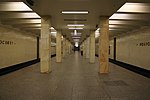
Dubrovka (Lyublinsko-Dmitrovskaya line)

Dubrovka (Russian: Дубровка) is a station on the Moscow Metro's Lyublinsko–Dmitrovskaya line. Originally the station was to open along with the first stage of the Lyublinsky radius in 1995. However, it could not be opened because of problems with building an escalator tunnel in tough hydrological conditions. However, as the station is in the middle of an industrial zone, due to the economic difficulties of the late 1990s that hit Russia, most of these recently privatised industries were very short of finances and their production output was likewise stalled. This was enough to prevent additional heating of the frozen earth and finally on 11 December 1999 the Moscow's mayor Yury Luzhkov opened the station. The station in its design is identical to its neighbour Krestyanskaya Zastava where both are wall-columned with no underplatform service spaces. With no solid theme, the station (work of architects Ye.Barsky, V.Fillipov and S.Belyakova) is decorated with bright monochromatic marble on the columns and walls. The floor is covered in red and black granite. The station is decorated by a bright mosaic in the end of the central hall (artist Zurab Tsereteli). The vestibule of the station is interlinked with a subway network under the Sharikopodshipnikovskaya street, with modern glazed metal and concrete pavilions. The average passenger traffic is 14,400 people per day. Behind the station there is a piston junction used for emergency reversals of trains.

Novospassky Monastery

Novospassky Monastery (New Monastery of the Savior, Russian: Новоспасский монастырь) is one of the fortified monasteries surrounding Moscow from the south-east. Like all medieval Russian monasteries, it was built by the Russian Orthodox Church. The abbey traces its history back to Moscow's first monastery established in the early 14th century at the location where the Danilov Monastery now stands. The Church of the Savior in the Wood (Собор Спаса на Бору) of the Kremlin, the oldest church of Moscow, was its original katholikon. Upon its removal to the left bank of the Moskva River in 1491, the abbey was renamed Abbey of the New Savior, to distinguish it from the older one in the Kremlin.The monastery was patronized by Andrei Kobyla's descendants, including the Sheremetev and Romanov boyars, and served as their burial vault. Among the last Romanovs buried in the monastery were Xenia Shestova (the mother of the first Romanov Tsar), Princess Tarakanova (a pretender who claimed to have been the only daughter of Empress Elisabeth) and Grand Duke Sergei Alexandrovich of Russia. In 1571 and 1591, the wooden citadel withstood repeated attacks by Crimean Tatars. Upon the Romanovs' ascension to the Moscovy throne, Michael of Russia completely rebuilt their family shrine in the 1640s. Apart from the large 18th-century bell-tower (one of the tallest in Moscow) and the Sheremetev sepulcher in the Church of the Sign, all other buildings date from that period. They include: The Cathedral of the Transfiguration (Russian: Преображенский собор) (1645–49), a large five-domed katholikon with frescoes by the finest Muscovite painters of the 17th century The Intercession Church (Russian: Покровская церковь) or Church of the Veil of the Virgin (1673–1675) with a refectory The Church of the Sign or Church of the Znamenie Icon of the Virgin (1791–1795) The bell tower (1759–1785) The infirmary Church of St. Nicholas the Miracle Worker and monks' living quarters The house of Patriarch Filaret The House of Loaf-Giving.During the Soviet years, the monastery was converted into a prison, then into a police drunk tank. In the 1970s, it was assigned to an art restoration institute, and finally returned to the Russian Orthodox Church in 1991.