place

National Unity Bridge

Bridge (structure) stubsBridges completed in 1970Bridges in EcuadorBuildings and structures in GuayaquilEcuador stubs
Ecuadorian building and structure stubsSouth American building and structure stubs

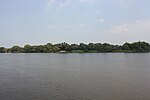
The National Unity Bridge (Puente de la Unidad Nacional) is a bridge complex in northeastern Guayaquil, Ecuador with a length of 2,186 metres (7,172 ft). The National Unity Bridge crosses the Daule River and Babahoyo River, which combine to form the Guayas River immediately downstream. The bridge complex consists of four individual bridges: two parallel bridges across the Daule River (the Rafael Mendoza Avilés Bridge and the Carlos Pérez Peraso Bridge) and two parallel bridges across the Babahoyo River, along with a road in La Puntilla, Samborondón that links each set of bridges. The bridge connects the city of Guayaquil with Durán to its east, and by extension to the highland part of Ecuador. Construction of the National Unity Bridge commenced on 23 March 1967, and the bridge was inaugurated on 9 October 1970.

Excerpt from the Wikipedia article National Unity Bridge (License: CC BY-SA 3.0, Authors).

National Unity Bridge
Ciclovía Puente de la Unidad Nacional - Tramo 2, Durán

Geographical coordinates (GPS) Address External links Nearby Places
placeShow on map

Wikipedia: National Unity BridgeContinue reading on Wikipedia

Geographical coordinates (GPS)

Latitude Longitude
N -2.1586111111111 ° E -79.855 °
placeShow on map

Address

Puente de la Unidad Nacional

Ciclovía Puente de la Unidad Nacional - Tramo 2
092410 Durán
Guayas, Ecuador
mapOpen on Google Maps

linkWikiData (Q6091521)
linkOpenStreetMap (722639902)

Share experience

Nearby Places

Durán, Ecuador
Durán, Ecuador

Durán, is a canton located in the province of Guayas, Ecuador, near the confluence of the Daule & Babahoyo rivers, where the Guayas River enters the ocean. It is located across the Guayas River from Guayaquil. Its township or capital is Eloy Alfaro. The canton was created in 1986 during the presidential period of Leon Febres Cordero through a presidential decree. The name "Eloy Alfaro" was chosen because of the Ecuadorian ex-president Eloy Alfaro Delgado. According to the National census in 2010, there are 235,769 people residing within the canton limits. Many of its inhabitants commute to other places for work and it can be considered a "dormitory town". However, many people who live in Durán find work within the canton by opening "comedores" or small restaurants, selling produce at the market, or even opening little stores with basic produce and house necessities. The towns Durán, Samborondón, and Guayaquil are connected by the bridge Rafael Mendoza Avilés. Durán is also well known for being the first railroad hub in Ecuador. It is the coastal railhead for the Ecuadorean rail network, and the closest point to Guayaquil because the railroad does not bridge the Guayas River. Since July 2007, a government program for the railroad reactivation began as well as the railroad connecting Duran with other cities located in the highlands of Ecuador. The Empresa de Ferrocarriles Ecuatorianos offers rail service aimed at tourists to Quito.

Guayaquil Municipal Museum

Guayaquil Municipal Museum (Spanish: Museo Municipal de Guayaquil) is a museum in Guayaquil, Ecuador. It contains artifacts, objects and historical items relating to the history of Guayaquil. It is considered the most important of the city and one of the best in the country. It is located in the center of the city of Guayaquil, in the same building as the Municipal Library. Admission is free, but passports are required.The museum has its origins in 1863 when an industrial museum was started by the politician and writer Pedro Carbo Noboa, making it the oldest in Ecuador, but it was not until 1908 that the museum was officially founded. The first director was Camilo Destruge Illingworth. The museum has gone through a variety of moves and renovations, acquiring its own building for the first time in 1916.The museum's website outlines the following rooms: Pre-Hispanic Room: ceramic, metal, and stone objects and handicrafts from the Valdivia, Machalilla and Chorrera cultures Colonial Room: includes Spanish firearms, a diorama from the old church of Santo Domingo, the layouts of Guayaquil traced between 1170 and 1772 by Francisco Requena and Ramon Garcia de Leon y Pizarro, and a scale model of the city made by architect Parsival Castro according to a sketch made in 1858 by Manuel Villavicencio" Religious Art Room: "an exhibition of mystic scenes comprised by religious paintings from the churches of Guayaquil; icons and archetypes of sacred art, and sculptures crafted by colonial artists like Diego Robles" Numismatic Room: coins, particularly the barter systemThe museum also has a collection of tsantsas, or shrunken heads.