place

Cedar Grove Plantation Chapel

1850 establishments in South Carolina19th-century Episcopal church buildingsCarpenter Gothic church buildings in South CarolinaChurches completed in 1850Churches in Georgetown County, South Carolina
Churches on the National Register of Historic Places in South CarolinaFormer Episcopal church buildings in South CarolinaNational Register of Historic Places in Georgetown County, South CarolinaPee Dee South Carolina Registered Historic Place stubs
Cedar Grove Plantation Chapel

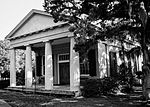
Cedar Grove Plantation Chapel, also known as Summer Chapel, All Saints' Episcopal Church, and Waccamaw, is a historic plantation chapel located near Pawleys Island, Georgetown County, South Carolina. It was built about 1850, and is a small, frame vernacular Gothic Revival style chapel. It features a pedimented portico supported by four, paneled, square columns. The chapel is associated with All Saints Church.It was listed on the National Register of Historic Places in 1991.

Excerpt from the Wikipedia article Cedar Grove Plantation Chapel (License: CC BY-SA 3.0, Authors, Images).

Cedar Grove Plantation Chapel
Waccamaw Neck Bikeway,

Geographical coordinates (GPS) Address Nearby Places
placeShow on map

Wikipedia: Cedar Grove Plantation ChapelContinue reading on Wikipedia

Geographical coordinates (GPS)

Latitude Longitude
N 33.467222222222 ° E -79.138611111111 °
placeShow on map

Address

Waccamaw Neck Bikeway

Waccamaw Neck Bikeway
29585
South Carolina, United States
mapOpen on Google Maps

Cedar Grove Plantation Chapel
Share experience

Nearby Places

All Saints Church (Pawleys Island, South Carolina)

All Saints Church Pawleys Island is a historic church complex and national historic district located on Pawleys Island, Georgetown County, South Carolina. The district encompasses three contributing buildings and one contributing site—the sanctuary, cemetery, rectory, and chapel. In 2004, it left the Episcopal Church to join the Diocese of the Carolinas, now part of the Anglican Church in North America, a denomination within the Anglican realignment movement. The sanctuary, built 1916–1917, the fourth to serve this congregation, is significant as an excellent example of the Classical Revival style, adapting the design of the church's 19th century sanctuary which burned in 1915. It is a one-story rectangular brick building sheathed in scored stucco. It has an engaged pedimented portico supported by four fluted Greek Doric order columns. A Doric frieze, composed of triglyphs, metopes, and guttae, runs under the cornice around the building on three sides. The church has a large center aisle sanctuary with a coved tray ceiling. The church cemetery, established in the 1820s, is significant for the persons buried there, many of whom were the leading public figures of antebellum Georgetown County. It is also significant a collection of outstanding gravestone art from about 1820 to 1900. The church rectory, built in 1822, is an intact example of a Carolina I-house. Its first congregation was formed in 1739, and the church has been located at this site since then. Associated with the church is the separately listed Cedar Grove Plantation Chapel.It was added to the National Register of Historic Places in 1991.