place

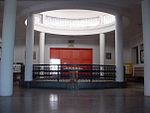
Russian Orthodox Church in Rabat

Churches in MoroccoEastern Orthodox church buildings in MoroccoMorocco stubsReligious buildings and structures in RabatRussian Orthodox church buildings
Russian Orthodox Church in Rabat. 2015

Holy Resurrection Church (Russian: Церковь Воскресения Христова) in Rabat is the oldest of three functioning Orthodox churches in Morocco. It is under the jurisdiction of the Russian Orthodox Church.

Excerpt from the Wikipedia article Russian Orthodox Church in Rabat (License: CC BY-SA 3.0, Authors, Images).

Russian Orthodox Church in Rabat
Rue Bab Tamesna زنقة باب تامسنا, Rabat Océan ⵍⵎⵓⵃⵉⵟ المحيط

Geographical coordinates (GPS) Address Phone number Website External links Nearby Places
placeShow on map

Wikipedia: Russian Orthodox Church in RabatContinue reading on Wikipedia

Geographical coordinates (GPS)

Latitude Longitude
N 34.011888888889 ° E -6.8520666666667 °
placeShow on map

Address

Église orthodoxe russe

Rue Bab Tamesna زنقة باب تامسنا
10050 Rabat, Océan ⵍⵎⵓⵃⵉⵟ المحيط
Morocco
mapOpen on Google Maps

Phone number

call+212808584295

Website
orthodox.ma

linkVisit website

linkWikiData (Q4504655)
linkOpenStreetMap (2052327666)

Russian Orthodox Church in Rabat. 2015
Share experience

Nearby Places

National Graduate Engineering School - Mines Rabat

The École Nationale Supérieure des Mines de Rabat (ENSMR) called also Mines Rabat in French or Rabat School of Mines in English is a leading Grande école engineering school in Morocco. The previous school's name was École Nationale de l'Industrie Minérale (ENIM; National School of the Mineral Industry). Based in Rabat, Mines Rabat is one of the oldest engineering schools in Morocco. Mines Rabat is a member of the Conférence des grandes écoles (CGE). The course for the engineering program lasts three years and the admission is done mainly by the common national competition (CNC) after making two or three years of preparatory classes. Grandes Écoles are institutions of higher education that are separate from, but parallel and connected to the main framework of the Moroccan-French public university system. Similar to the Ivy League in the United States, Oxbridge in the UK, and C9 League in China, Grandes Écoles are elite academic institutions that admit students through an extremely competitive process. Mines Rabat's Alumni go on to occupy elite positions within government, administration, and corporate firms in Morocco. Despite its small size (fewer than 300 students are accepted each year, after a very selective exam), it is a crucial part of the infrastructure of the Moroccan industry. Based in Rabat, it is one of the oldest engineering schools in Morocco. Mines Rabat is a member of the Conférence des grandes écoles (CGE). The course for the engineering program lasts three years and the admission is done mainly by the common national competition (CNC) after making two or three years of preparatory classes. In the limit of available places candidates can be admitted to the Engineering Cycle by level: Associate Bachelor University's MasterThe engineering cycle is 3 years for applicants holding an associate's or a bachelor's degree and is 2 years for applicants holding a, master's degree. The Ph.D. and Deng cycles are 3 to 5 years for applicants holding an engineering degree or a master's degree. The school has similarities with the Mines ParisTech, Mines Saint-Étienne, and Mines Nancy schools in France, Columbia School of Mines, Colorado School of Mines in the USA, and Royal School of Mines in the UK

Rabat
Rabat

Rabat (, also UK: , US: ; Arabic: الرباط, romanized: a-Ribāṭ; Berber languages: ⵕⵕⴱⴰⵟ, romanized: ṛṛbaṭ) is the capital city of Morocco and the country's seventh-largest city with an urban population of approximately 580,000 (2014) and a metropolitan population of over 1.2 million. It is also the capital city of the Rabat-Salé-Kénitra administrative region. Rabat is located on the Atlantic Ocean at the mouth of the river Bou Regreg, opposite Salé, the city's main commuter town. Rabat was founded in the 12th century by the Almohads. The city grew at first but went into an extended period of decline following the collapse of the Almohads and in the 17th century, Rabat became a haven for Barbary pirates. When the French established a protectorate over Morocco in 1912 they made Rabat its administrative center. When Morocco achieved independence in 1955 Rabat became its capital. Rabat, Temara, and Salé form a conurbation of over 1.8 million people. Silt-related problems have diminished Rabat's role as a port; however, Rabat and Salé still maintain important textile, food processing and construction industries. In addition, tourism and the presence of all foreign embassies in Morocco make Rabat one of the most important cities in the country. The Moroccan capital was ranked at second place by CNN in its "Top Travel Destinations of 2013". It is one of four Imperial cities of Morocco, and the medina of Rabat is listed as a World Heritage Site. Rabat is accessible by train through the ONCF system and by plane through the nearby Rabat–Salé Airport.