place

Saint-Sauveur (electoral district)

Former provincial electoral districts of Quebec

Saint-Sauveur was a former provincial electoral district in the Capitale-Nationale region of Quebec, Canada. It was created for the 1890 election from part of Québec-Est electoral district. Its final election was in 1970. It disappeared in the 1973 election and its successor electoral districts were Taschereau and Vanier.

Excerpt from the Wikipedia article Saint-Sauveur (electoral district) (License: CC BY-SA 3.0, Authors).

Saint-Sauveur (electoral district)
Rue Soumande, Quebec Vanier (Les Rivières)

Geographical coordinates (GPS) Address Nearby Places
placeShow on map

Wikipedia: Saint-Sauveur (electoral district)Continue reading on Wikipedia

Geographical coordinates (GPS)

Latitude Longitude
N 46.818 ° E -71.254 °
placeShow on map

Address

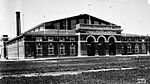
Halles Fleur de Lys

Rue Soumande
G1L 4W5 Quebec, Vanier (Les Rivières)
Quebec, Canada
mapOpen on Google Maps

Share experience

Nearby Places

CHRC (AM)

CHRC was a French language Canadian radio station located in Quebec City, Quebec. Known as Québec 800, the station had a news/talk/sports format. Founded in 1926, it was the oldest station in Quebec City at the time of its shutdown. Owned and operated by the Quebec Remparts QMJHL franchise, it broadcast on 800 kHz with a power of 50,000 watts as a class B station from a site near the Chaudière River near Saint-Étienne-de-Lauzon in Lévis, using a very directional antenna (six towers) with the same directional pattern day and night to protect various other stations on the same frequency, including CJAD in Montreal (which is approximately 250 kilometres (160 mi) away). The station's studios were located at Colisée Pepsi in Quebec City. It was previously part of the Radiomédia/Corus Québec network, which operated across Quebec. On August 9, 2007, Corus announced a deal to sell the station to a group of local businessmen, namely Michel Cadrin, Jacques Tanguay and Patrick Roy, owners of the Remparts. The new owners plan on converting the station to a primarily sports-based format. This application was approved by the CRTC on June 26, 2008.CHRC's alumni include former Premier of Quebec René Lévesque, who was a substitute announcer for CHRC during 1941 and 1942. CHRC announced it would cease operations at the end of the month of September 2012, at the same time discontinuing the last AM radio service from Quebec City. Sports broadcast rights would soon be transferred to CJMF-FM. CHRC fell silent late in the evening of September 30, 2012. Before leaving the air at 6:06 p.m., the station's final words broadcast were farewell messages from their staff. Parties interested in acquiring 800 included the Tietolman-Tétrault-Pancholy Media group and Bell Media Radio, though no deals were made since the station's closure. CHRC's programming and document archives were since donated to the Bibliothèque et Archives nationales du Québec.The CHRC callsign would later be reassigned to a new FM station in Clarence-Rockland, Ontario, as CHRC-FM.

Cartier-Brébeuf National Historic Site

Cartier-Brébeuf National Historic Site is a National Historic Site of Canada and so designated by the Historic Sites and Monuments board of Canada in 1958 under the recommendation of John Diefenbaker, the Prime Minister of Canada at the time. It is administered by Parks Canada and located at the confluence of Saint-Charles and Lairet rivers, in Quebec City, Quebec, Canada, more precisely in La Cité-Limoilou borough. On the site you can find an interpretation centre and a 6,8 hectares inner-city park characterised by an uneven landscape and divided into two sectors "East" and "West" separated by the Lairet river. Several commemorative monuments and elements are also present. The site commemorates the second voyage of Jacques Cartier; more precisely in 1535-1536 when he and his shipmates wintered near the Iroquoian village of Stadacona (Quebec City). It also recalls the establishment of the first residence of the Jesuit missionaries in Quebec, in 1625-1626. Moreover, by the end of the 17th century up to the opening of the national historic site in 1972, it hosted numerous hand-crafted and industrial activities such as a tannery, a pottery, a brickyard, a shipyard, a sawmill, a junkyard and a snow-dumping lot. Today, the site offers a museum exhibition, animations for elementary and high school groups, thematic events, and a natural habitat in an inner-city park. A cycleway and the linear park of Saint-Charles river also cross the park's ground.