place

National Gallery of Bosnia and Herzegovina

1946 establishments in Bosnia and HerzegovinaArt museums and galleries in Bosnia and HerzegovinaArt museums established in 1946Culture in Sarajevo
Umjetnicka galerija BiH

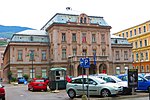
The National Gallery of Bosnia and Herzegovina (Bosnian, Croatian and Serbian: Umjetnička galerija Bosne i Hercegovine / Умјетинчка галерија Босне и Херцеговине) is a national gallery of art in Bosnia and Herzegovina, located in Sarajevo. The gallery was established on October 11, 1946, and contains over 6000 pieces of art. Its main focus are the works of Bosnian and Herzegovinian interest. The gallery was open and held exhibitions during the whole period of the siege of Sarajevo and the Bosnian war in 1992-1995. However, afterwards it received considerably less funding due to the failure of the government of Bosnia and Herzegovina to recognize the gallery as a national institution.The National Gallery of Bosnia and Herzegovina was closed in September 2011 for almost a year because the gallery was unable to appoint a new director. The institution was opened in August 2012 with the arrival of acting director Strajo Krsmanović.

Excerpt from the Wikipedia article National Gallery of Bosnia and Herzegovina (License: CC BY-SA 3.0, Authors, Images).

National Gallery of Bosnia and Herzegovina
Zelenih beretki, Sarajevo MZ "Ferhadija" (Stari Grad Municipality)

Geographical coordinates (GPS) Address External links Nearby Places
placeShow on map

Wikipedia: National Gallery of Bosnia and HerzegovinaContinue reading on Wikipedia

Geographical coordinates (GPS)

Latitude Longitude
N 43.857777777778 ° E 18.424444444444 °
placeShow on map

Address

Umjetnička galerija Bosne i Hercegovine

Zelenih beretki 8
71000 Sarajevo, MZ "Ferhadija" (Stari Grad Municipality)
Federation of Bosnia and Herzegovina, Bosnia and Herzegovina
mapOpen on Google Maps

linkWikiData (Q13090849)
linkOpenStreetMap (131846402)

Umjetnicka galerija BiH
Share experience

Nearby Places

Hotel Central (Sarajevo)

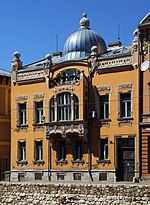
Hotel Central is a historic hotel located in the center of the Bosnian capital, Sarajevo. It stands at the corner of Zelenih Beretki and Ćumurija streets. It was built in the 1880s, as part of the development of the Bosnian capital during Austro-Hungarian rule. The building was designed by Croatian architect Josip Vancaš. Unlike many other buildings constructed at that time in the emerging modern center of Sarajevo—buildings that referenced the architecture of Vienna and other cities of the monarchy, Vancaš drew inspiration from Oriental architecture, particularly Islamic design. For the two-story corner building, he designed windows in shapes typical of the Middle East with oriental motifs and horseshoe arches on the first floor. He emphasized the corner of the building with a first-floor balcony and a dome. The hotel was completed in 1889 and became the second hotel in the city, following Hotel Europe. The name Central was chosen because, at the time, Franz Joseph Street - today known as Zelenih beretki - served as the city’s main promenade. The hotel was completed in 1889 based on a design by architect Josip Vancaš and was financed by the city’s waqf (Islamic endowment). The building has three floors. Given its location on one of the most prominent sites in the city center, the Waqf Commission decided to lease out the entire building under the condition that a café would be established on the ground floor. The site where the hotel now stands was originally occupied by the Ajas Pasha Mosque, which was destroyed in 1697 when Eugene of Savoy set fire to Sarajevo. Although the mosque was rebuilt shortly thereafter, it was once again destroyed in a major fire that broke out in the Latinluk district in 1879. Following this second destruction, the mosque was not rebuilt. Instead, the waqf (Islamic endowment) decided to finance the construction of a hotel on the same site, which became known as Ajas Pasha’s Court (Ajas-pašin dvor). During the war in the 1990s, the hotel was largely destroyed and later completely reconstructed. During the restoration, only the outer walls were preserved, and the interior of the building was entirely rebuilt. The renovation of the façade aimed primarily to preserve the original architectural design of the decorative elements. The reconstruction was completed in 2008. The hotel is owned and managed by the Irish company Templeville Developments Ltd. and includes the Westwood Club & Spa within its facilities.