place

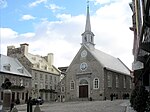
Habitation de Québec

Buildings and structures in Quebec CityHistory of Quebec City
Habitation Québec
Habitation Québec

Habitation de Québec was an ensemble of buildings interconnected by Samuel de Champlain when he founded Québec during 1608. The site is located in what is now Vieux-Québec. It was located near the site of the abandoned First Nations village of Stadacona that Jacques Cartier had visited during 1535. It served as a fort and as dwellings for the new colony in New France.

Excerpt from the Wikipedia article Habitation de Québec (License: CC BY-SA 3.0, Authors, Images).

Habitation de Québec
Rue Saint-Pierre, Quebec

Geographical coordinates (GPS) Address Nearby Places
placeShow on map

Wikipedia: Habitation de QuébecContinue reading on Wikipedia

Geographical coordinates (GPS)

Latitude Longitude
N 46.8129 ° E -71.2025 °
placeShow on map

Address

Rue Saint-Pierre 29
G1K 4G6 Quebec (La Cité-Limoilou)
Quebec, Canada
mapOpen on Google Maps

Habitation Québec
Habitation Québec
Share experience

Nearby Places

Battle of Quebec (1775)

The Battle of Quebec (French: Bataille de Québec) was fought on December 31, 1775, between American Continental Army forces and the British defenders of Quebec City early in the American Revolutionary War. The battle was the first major defeat of the war for the Americans, and it came with heavy losses. General Richard Montgomery was killed, Benedict Arnold was wounded, and Daniel Morgan and more than 400 men were taken prisoner. The city's garrison, a motley assortment of regular troops and militia led by Quebec's provincial governor, General Guy Carleton, suffered a small number of casualties. Montgomery's army had captured Montreal on November 13, and early in December they became one force that was led by Arnold, whose men had made an arduous trek through the wilderness of northern New England. Governor Carleton had escaped from Montreal to Quebec, the Americans' next objective, and last-minute reinforcements arrived to bolster the city's limited defenses before the attacking force's arrival. Concerned that expiring enlistments would reduce his force, Montgomery made the end-of-year attack in a blinding snowstorm to conceal his army's movements. The plan was for separate forces led by Montgomery and Arnold to converge in the lower city before scaling the walls protecting the upper city. Montgomery's force turned back after he was killed by cannon fire early in the battle, but Arnold's force penetrated further into the lower city. Arnold was injured early in the attack, and Morgan led the assault in his place before he became trapped in the lower city and was forced to surrender. Arnold and the Americans maintained an ineffectual blockade of the city until spring, when British reinforcements arrived.

Rue du Petit-Champlain

Rue du Petit-Champlain (English: Little Champlain Street) is a street in the Canadian city of Quebec City, Quebec. It is located in the Petit Champlain commercial district, at the foot of Cap Diamant, and contains many boutique shops. Quartier du Petit Champlain is claimed to be the oldest commercial district in North America. It is named for Samuel de Champlain, who founded Quebec City in 1608.Rue du Petit-Champlain is around 0.16 miles (0.26 km) long, and runs from its convergence with Rue Sous-le-Fort in the north to Boulevard Champlain in the south. A popular viewing point of the street, the Breakneck Stairs (or Breakneck Steps), are located at the northern end of the street. Just beyond the steps is the lower entrance of the Funiculaire du Vieux-Québec, an electric cableway established in 1879. It takes passengers up and down Cap Diamant to and from Dufferin Terrace, beside the Château Frontenac. It climbs at a 45-degree angle, covering a total distance of 64 metres (210 ft).Around halfway along the street, on its western side, is Parc Félix-Leclerc. The western side of the street contains frontages of buildings, in the shadow of Cap Diamant to their rears, whereas the rears of the buildings facing Boulevard Champlain occupy the eastern side. A fresco painted on the side of the building at number 102 is a trompe-l'œil measuring 100m2 (900 ft2). It represents the history of the district, the bombardments of 1759, the landslides, and the fires which have occurred in the district.