place

Mission Creek (British Columbia)

British Columbia river stubsRivers of the Okanagan
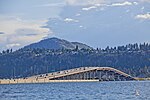
After Sunset on the Sandbar at the Mouth of Mission Creek

Mission Creek is a large creek in the Okanagan Region of British Columbia. Originally called N'wha-kwi-sen (smoothing stones), it was later mapped as Rivière de l’Anse-au-Sable (Sandy Bay River), the name Mission Creek was adopted in 1860 in honour of the Catholic Oblate Mission established by Father Pandosy and other settlers. The Creek rises in the Greystoke Mountain Range and runs west about 43 kilometres (27 mi) before emptying into Okanagan Lake south of Kelowna. Its watershed covers about 200,000 square kilometres (49,000,000 acres). Mission Creek was designated a BC Heritage River by the province in 1996.

Excerpt from the Wikipedia article Mission Creek (British Columbia) (License: CC BY-SA 3.0, Authors, Images).

Mission Creek (British Columbia)
Bluebird Road, Kelowna Lower Mission

Geographical coordinates (GPS) Address Nearby Places
placeShow on map

Wikipedia: Mission Creek (British Columbia)Continue reading on Wikipedia

Geographical coordinates (GPS)

Latitude Longitude
N 49.8425 ° E -119.49361111111 °
placeShow on map

Address

Bluebird Road

Bluebird Road
V1W 1A3 Kelowna, Lower Mission
British Columbia, Canada
mapOpen on Google Maps

After Sunset on the Sandbar at the Mouth of Mission Creek
Share experience

Nearby Places

Okanagan Mission, British Columbia

Okanagan Mission, also known colloquially as the Mission is a neighbourhood of the City of Kelowna in the Okanagan region of the Southern Interior of British Columbia, Canada, located on the south side of the city at the foot of Okanagan Mountain. It derives its name from the Okanagan Mission founded by Father Pandosy, historically known as the Okanagan Mission, which was located here and was the first non-native settlement in the Okanagan Valley.The Mission once was a separate jurisdiction before being amalgamated with the City of Kelowna in the mid- to late-20th century. This has caused a fairly vibrant secondary commercial centre to emerge which is entirely separate from Downtown, with low to moderate density residential areas in between. The northern border of Mission is K.L.O. Rd. It is often differentiated as the Lower Mission and Upper Mission. The Lower Mission contains most of the aforementioned commercial areas such as shopping malls, grocery stores, coffee shops, and boutiques. Lower Mission also has extensive recreational facilities, Mission Recreation Park has six softball diamonds as well as soccer fields, community gardens, playgrounds and trails, while neighbouring H2O is Kelowna's largest indoor recreation facility with a 50 m pool, water slides, diving boards and surfing wave. Gyro Beach and Rotary Beach, two of Kelowna's most popular beaches, are also located in the Lower Mission. The Upper Mission begins to extend into the foothills and higher terrain, and many parts of this area boast magnificent views of the city, mountains and Okanagan Lake. As a result, this part of town is widely regarded as luxurious and is indeed one of the most expensive neighbourhoods of Kelowna. It is not unusual to see homes worth one million dollars or more, the most expensive of which can reach five million or even slightly above.

WT Small House

WT Small House is reputed to be the oldest continually inhabited home in Kelowna, British Columbia, Canada. It is listed on the Kelowna Heritage Register as a highly valued example of early residential pioneer settlement in the Okanagan Valley. The Home was constructed with adze-cut squared logs and dovetail joints on two-storey wood frame. William Thomas Small, a blind miller at The Lequime Mill built the original portion of the house in 1890 with three of his sons, Fred, Charles and William. The fieldstone fireplace in the parlour is carved with the year of construction '1890'. The house was sold in 1908 to James Hugh Baillie, who added a two-storey wood frame front in 1910. Baillie sold the house in 1918 to C. Graham, whose wife is reputed to have built a second fieldstone fireplace in the sitting room. In 1930, the house was bought by Arthur H. Raymer (1880–1956) and his wife Edith Small, the daughter of WT Small (1884–1951) who had grown up in the house. Raymer's father had been Kelowna's first mayor when the city was incorporated in 1905. Raymer's daughter, Hilda and her husband W. Sinclair-Thompson lived there with their son and daughter Terry Gilbert and Wendy Edith. The Mulberry tree on the property was brought to Kelowna on a wagon from Ontario by William Small. The heritage value of the building is characterised by the organic growth of more than a century from early pioneer vernacular architecture to modern additions while retaining the original portions, still easily defined and recognisable today. Small's wife was instrumental in founding the first school in the Mission Creek area in 1894. Six local families (Small, Casorso, Berard, Crawford, Dickson and Smith) gathered to refurbish the old Fred Gillard cabin under the guidance of William Small, the only carpenter in the party, to provide the first school in the area for the eighteen local children. They were taught by Fred Watson until 1900 for the sum of $720 per year (Okanagan Historical Society).