place

Okanagan Lake Bridge

Bridges completed in 1958Buildings and structures demolished in 2009Buildings and structures in KelownaDemolished buildings and structures in British ColumbiaFormer toll bridges in Canada
Pontoon bridgesRoad bridges in British ColumbiaTransport in KelownaVertical lift bridges in Canada

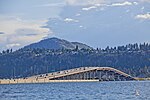
The Okanagan Lake Bridge (also known as the Kelowna Floating Bridge) was a three-lane, 650-metre (2,133-foot) long floating bridge in British Columbia, Canada. It crossed Okanagan Lake, connecting the Westside area to Kelowna on the lake's eastern side. Taller boats such as sailboats were able to pass under the lift span which was located at the east end of the bridge.

Excerpt from the Wikipedia article Okanagan Lake Bridge (License: CC BY-SA 3.0, Authors).

Okanagan Lake Bridge
Harvey Avenue, Kelowna

Geographical coordinates (GPS) Address Nearby Places
placeShow on map

Wikipedia: Okanagan Lake BridgeContinue reading on Wikipedia

Geographical coordinates (GPS)

Latitude Longitude
N 49.879648 ° E -119.511852 °
placeShow on map

Address

William R. Bennett Bridge

Harvey Avenue
V1Y 6N6 Kelowna
British Columbia, Canada
mapOpen on Google Maps

Share experience

Nearby Places

Kelowna
Kelowna

Kelowna ( (listen) kə-LOH-nə) is a city on Okanagan Lake in the Okanagan Valley in the southern interior of British Columbia, Canada. It serves as the head office of the Regional District of Central Okanagan. The name Kelowna derives from the Okanagan word kiʔláwnaʔ, referring to a male grizzly bear.Kelowna is the province's third-largest metropolitan area (after Vancouver and Victoria), while it is the seventh-largest city overall and the largest in the Interior. It is the 20th-largest metropolitan area in Canada. The city proper encompasses 211.85 km2 (81.80 sq mi), and the census metropolitan area 2,904.86 km2 (1,121.57 sq mi). Kelowna's estimated population in 2020 is 222,748 in the metropolitan area and 142,146 in the city proper. After many years of suburban expansion into the surrounding mountain slopes, the city council adopted a long-term plan intended to increase density instead - particularly in the downtown core. This has resulted in the construction of taller buildings, including One Water Street - a 36-storey building that is the tallest in Kelowna. Other highrise developments have already broken ground or been approved since then, including a 42-storey tower on Leon Avenue which will be the tallest building in the city, and among the tallest in B.C.Nearby communities include the City of West Kelowna (also referred to as Westbank and Westside) to the west, across Okanagan Lake; Lake Country and Vernon to the north; Peachland to the southwest; and Summerland and Penticton to the south.