place

Ministry of Health (Russia)

Federal ministries of RussiaHealth ministriesRussia stubs
Emblem of Ministry of Health of Russia

The Ministry of Health of the Russian Federation (Russian: Министерство здравоохранения Российской Федерации, in short Russian: Минздрав России, romanized: Minzdrav Rossii) is a ministry of the Government of Russia responsible for health care and public health. The Ministry of Health oversees the legal regulation and state policies of health in Russia, including pharmaceuticals, the public health care system, health insurance, medical rehabilitation, sanitation, disease prevention, and the circulation of medicines. It is headquartered in Tverskoy District, Moscow.The Ministry of Health was formed in 2012 from the Ministry of Health and Social Development which was split in two under Prime Minister Dmitry Medvedev, with the social security departments forming the Ministry of Labour and Social Affairs. Mikhail Murashko has been Minister of Health since 21 January 2020.

Excerpt from the Wikipedia article Ministry of Health (Russia) (License: CC BY-SA 3.0, Authors, Images).

Ministry of Health (Russia)
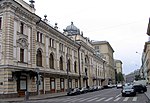
Rakhmanovskiy Lane, Moscow Tverskoy District

Geographical coordinates (GPS) Address Nearby Places
placeShow on map

Wikipedia: Ministry of Health (Russia)Continue reading on Wikipedia

Geographical coordinates (GPS)

Latitude Longitude
N 55.765261111111 ° E 37.618602777778 °
placeShow on map

Address

Rakhmanovskiy Lane 3
127051 Moscow, Tverskoy District
Moscow, Russia
mapOpen on Google Maps

Emblem of Ministry of Health of Russia
Share experience

Nearby Places

Vysokopetrovsky Monastery

Vysokopetrovsky Monastery (Russian: Высокопетровский монастырь, English: High Monastery of St Peter) is a Russian Orthodox monastery in the Bely Gorod area of Moscow, commanding a hill whence Petrovka Street descends towards the Kremlin. The monastery is believed to have been founded around the 1320s by Saint Peter of Moscow, the first Russian metropolitan to have his see in Moscow. The cloister gave its name to adjacent Petrovka Street, one of the streets radiating from Red Square. In the late 17th century, the Naryshkin boyars, maternal relatives of Peter the Great, turned the monastery into their family burial place. They had it reconstructed in the Naryshkin Baroque style of architecture associated with their name. In the mid-18th century, several subsidiary structures were added, possibly based on designs by Dmitry Ukhtomsky or Ivan Fyodorovich Michurin. The katholikon, dedicated to St Peter of Moscow, was long regarded as a typical monument of the Naryshkin style and dated to 1692. In the 1970s, however, detailed studies of written sources and excavations of the site revealed that the katholikon actually had been built in 1514-1517 by Aloisio the New.After the monastery was closed down by the Soviet authorities in 1929, Archimandrite Bartholomew Remov arranged for the monks and nuns to continue their monastic life in secret at the Nativity Church at Putinki, where he was the Rector. The spiritual life of the monastery continued at Putinki until the NKVD was informed and arrested everyone involved in 1935.In 1992 several buildings of the monastery were returned to the Russian Orthodox Church. As of 2005, the buildings are shared by the Russian Orthodox Church and the Moscow Literature Museum.

Moscow Architectural Institute

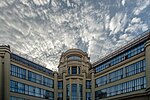
Moscow Architectural Institute (State Academy) - MArchI (Russian: Московский Архитектурный Институт (Государственная Академия) - МАрхИ) is a famous architecture school located in Moscow, Russia. MArchI trains architects of wide-range specialization in Town-Planning, Architecture of Residential and Public Buildings, Architectural Design, Architecture of Industrial Buildings, Architecture of Agricultural Complexes, Theory and History of Architecture, Restoration of Architectural Monuments, Interior Architecture, Landscaping. The language of education is Russian. The full course of studies lasts 6 years. After that students get the diploma and can work as architects in Russia. After 5 years of education students get the bachelor's diploma. The Rector of the university is Dmitry Olegovich Shvidkovsky.There are 28 departments in the Academy, 10 of them are with specialized, 18 are for the whole faculty: Architecture of public buildings Architecture of industrial structures Architecture of rural settlements Urban planning Reconstruction in architecture Restoration in architecture Landscape architecture History of architecture and urban planning Design of Architectural Environment Temple ArchitectureSince 2010, the academy releases an international electronic scientific and educational magazine "Architecture and Modern Information Technologies".Since 1994, the Institute has been accredited by the Royal Institute of British Architects.