place

Neglinnaya Street

Moscow geography stubsRussia road stubsStreets in Moscow
Neglinnaya, 14
Neglinnaya, 14

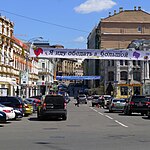
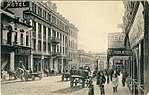
Neglinnaya Street (Russian: Неглинная улица) is a street inside the Garden Ring of Moscow, Russia. It runs from the Bolshoi Theatre to the Trubnaya Square. The street was paved over the underground Neglinnaya River in 1819. Throughout the 20th century the river regularly flooded the street and the adjacent quarter. The highlights of the Neglinnaya include the Muir & Mirrielees building, the Petrovka Passazh, the Sandunov Baths, and the Central Bank of the Russian Federation.

Excerpt from the Wikipedia article Neglinnaya Street (License: CC BY-SA 3.0, Authors, Images).

Neglinnaya Street
Neglinnaya Street, Moscow Meshchansky District

Geographical coordinates (GPS) Address Nearby Places
placeShow on map

Wikipedia: Neglinnaya StreetContinue reading on Wikipedia

Geographical coordinates (GPS)

Latitude Longitude
N 55.763888888889 ° E 37.62 °
placeShow on map

Address

Neglinnaya Street 14 с1А
107016 Moscow, Meshchansky District
Moscow, Russia
mapOpen on Google Maps

Neglinnaya, 14
Neglinnaya, 14
Share experience

Nearby Places

Moscow Architectural Institute

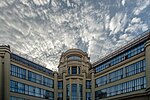
Moscow Architectural Institute (State Academy) - MArchI (Russian: Московский Архитектурный Институт (Государственная Академия) - МАрхИ) is a famous architecture school located in Moscow, Russia. MArchI trains architects of wide-range specialization in Town-Planning, Architecture of Residential and Public Buildings, Architectural Design, Architecture of Industrial Buildings, Architecture of Agricultural Complexes, Theory and History of Architecture, Restoration of Architectural Monuments, Interior Architecture, Landscaping. The language of education is Russian. The full course of studies lasts 6 years. After that students get the diploma and can work as architects in Russia. After 5 years of education students get the bachelor's diploma. The Rector of the university is Dmitry Olegovich Shvidkovsky.There are 28 departments in the Academy, 10 of them are with specialized, 18 are for the whole faculty: Architecture of public buildings Architecture of industrial structures Architecture of rural settlements Urban planning Reconstruction in architecture Restoration in architecture Landscape architecture History of architecture and urban planning Design of Architectural Environment Temple ArchitectureSince 2010, the academy releases an international electronic scientific and educational magazine "Architecture and Modern Information Technologies".Since 1994, the Institute has been accredited by the Royal Institute of British Architects.

Bolshoi Theatre
Bolshoi Theatre

The Bolshoi Theatre (Russian: Большо́й теа́тр, tr. Bol'shoy teatr, literally "Big Theater", IPA: [bɐlʲˈʂoj tʲɪˈatər]) is a historic theatre in Moscow, Russia, originally designed by architect Joseph Bové, which holds ballet and opera performances. Before the October Revolution it was a part of the Imperial Theatres of the Russian Empire along with Maly Theatre (Small Theatre) in Moscow and a few theatres in Saint Petersburg (Hermitage Theatre, Bolshoi (Kamenny) Theatre, later Mariinsky Theatre and others). The Bolshoi Ballet and Bolshoi Opera are among the oldest and best known ballet and opera companies in the world. It is by far the world's biggest ballet company, with more than 200 dancers. The theatre is the parent company of The Bolshoi Ballet Academy, a leading school of ballet. It has a branch at the Bolshoi Theater School in Joinville, Brazil.The main building of the theatre, rebuilt and renovated several times during its history, is a landmark of Moscow and Russia (its iconic neoclassical façade is depicted on the Russian 100-ruble banknote). On 28 October 2011, the Bolshoi re-opened after an extensive six-year renovation. The official cost of the renovation is 21 billion rubles ($688 million). However, other Russian authorities and other people connected to it claimed much more public money was spent. The renovation included restoring acoustics to the original quality (which had been lost during the Soviet Era), as well as restoring the original Imperial decor of the Bolshoi.