place

Petrovsky Boulevard

Boulevards in MoscowMoscow geography stubs
Petrovsky Boulevard, 2010 01

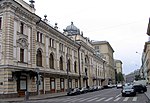
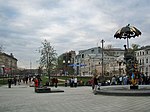
Petrovsky Boulevard, (Russian: Петровский Бульвар), is a major boulevard in Moscow. It begins at the Petrovsky Gates Square (Petrovka Street) and ends at Trubnaya Square, completing the link of Boulevard Ring between Strastnoy Boulevard and Rozhdestvensky Boulevard. The boulevard (as well as Petrovka Street and Petrovsky Gates) is named after Vysoko-Petrovsky Monastery. Apart from the monastery, there is still a fairly high (but shrinking) share of genuine 19th century buildings.

Excerpt from the Wikipedia article Petrovsky Boulevard (License: CC BY-SA 3.0, Authors, Images).

Petrovsky Boulevard
Petrovskiy Blvd, Moscow Tverskoy District

Geographical coordinates (GPS) Address Nearby Places
placeShow on map

Wikipedia: Petrovsky BoulevardContinue reading on Wikipedia

Geographical coordinates (GPS)

Latitude Longitude
N 55.7677777878 ° E 37.61750001 °
placeShow on map

Address

Петровский бульвар

Petrovskiy Blvd
127051 Moscow, Tverskoy District
Moscow, Russia
mapOpen on Google Maps

Petrovsky Boulevard, 2010 01
Share experience

Nearby Places

Vysokopetrovsky Monastery

Vysokopetrovsky Monastery (Russian: Высокопетровский монастырь, English: High Monastery of St Peter) is a Russian Orthodox monastery in the Bely Gorod area of Moscow, commanding a hill whence Petrovka Street descends towards the Kremlin. The monastery is believed to have been founded around the 1320s by Saint Peter of Moscow, the first Russian metropolitan to have his see in Moscow. The cloister gave its name to adjacent Petrovka Street, one of the streets radiating from Red Square. In the late 17th century, the Naryshkin boyars, maternal relatives of Peter the Great, turned the monastery into their family burial place. They had it reconstructed in the Naryshkin Baroque style of architecture associated with their name. In the mid-18th century, several subsidiary structures were added, possibly based on designs by Dmitry Ukhtomsky or Ivan Fyodorovich Michurin. The katholikon, dedicated to St Peter of Moscow, was long regarded as a typical monument of the Naryshkin style and dated to 1692. In the 1970s, however, detailed studies of written sources and excavations of the site revealed that the katholikon actually had been built in 1514-1517 by Aloisio the New.After the monastery was closed down by the Soviet authorities in 1929, Archimandrite Bartholomew Remov arranged for the monks and nuns to continue their monastic life in secret at the Nativity Church at Putinki, where he was the Rector. The spiritual life of the monastery continued at Putinki until the NKVD was informed and arrested everyone involved in 1935.In 1992 several buildings of the monastery were returned to the Russian Orthodox Church. As of 2005, the buildings are shared by the Russian Orthodox Church and the Moscow Literature Museum.