place

Alabama Department of Archives and History

1901 establishments in AlabamaBuildings and structures in Montgomery, AlabamaCivil rights movement museumsGovernment agencies established in 1901History museums in Alabama
Museums in Montgomery, AlabamaOrganizations based in AlabamaState agencies of AlabamaState archives of the United StatesState government buildings in AlabamaState history organizations of the United StatesUse mdy dates from August 2022
Alabama Department of Archives & History Apr2009

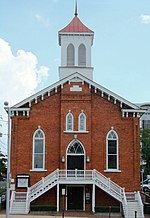
The Alabama Department of Archives and History is the official repository of archival records for the U.S. state of Alabama. Under the direction of Thomas M. Owen its founder, the agency received state funding by an act of the Alabama Legislature on February 27, 1901. Its primary mission is the collecting and preserving of archives, documents and artifacts relating to the history of the state. It was the first publicly funded, independent state archives agency in the United States. It subsequently became a model for the establishment of archives in other states. Today the agency identifies, preserves, and makes accessible records and artifacts significant to the history of the state and serves as the official repository for records created by Alabama's state agencies.

Excerpt from the Wikipedia article Alabama Department of Archives and History (License: CC BY-SA 3.0, Authors, Images).

Alabama Department of Archives and History
Avenue of Flags, Montgomery

Geographical coordinates (GPS) Address Website Nearby Places
placeShow on map

Wikipedia: Alabama Department of Archives and HistoryContinue reading on Wikipedia

Geographical coordinates (GPS)

Latitude Longitude
N 32.375555555556 ° E -86.300277777778 °
placeShow on map

Address

Alabama Department of Archives and History

Avenue of Flags
36130 Montgomery
Alabama, United States
mapOpen on Google Maps

Website
archives.state.al.us

linkVisit website

Alabama Department of Archives & History Apr2009
Share experience

Nearby Places

Alabama State Capitol

The Alabama State Capitol, listed on the National Register of Historic Places as the First Confederate Capitol, is the state capitol building for Alabama. Located on Capitol Hill, originally Goat Hill, in Montgomery, it was declared a National Historic Landmark on December 19, 1960. Unlike every other state capitol, the Alabama Legislature does not meet there, but at the Alabama State House. The Capitol has the governor's office and otherwise functions as a museum.Alabama has had five political capitals and four purpose-built capitol buildings during its history since it was designated as a territory of the United States. The first was the territorial capital in St. Stephens in 1817; the state organizing convention was held in Huntsville in 1819, and the first permanent capital was designated in 1820 as Cahaba. The legislature moved the capital to Tuscaloosa in 1826, where it was housed in a new three-story building. The 1826 State House in Tuscaloosa was later used as Alabama Central Female College. After it burned in 1923, the ruins were retained within Capitol Park. Finally, in 1846, the capital was moved again, when Montgomery was designated. The first capitol building in Montgomery, located where the current building stands, burned after two years. The current building was completed in 1851, and additional wings were added over the course of the following 140 years. These changes followed population growth in the state as many slave-holding European-American settlers arrived. Large parts of the state were subsequently developed for cotton cultivation. The current capitol building temporarily served as the Confederate Capitol while Montgomery served as the first political capital of the Confederate States of America in 1861, before Richmond, Virginia was designated as the capital. Delegates meeting as the Montgomery Convention in the Senate Chamber drew up the Provisional Constitution of the Confederate States on February 4, 1861. The convention also adopted the Permanent Constitution here on March 11, 1861.In 1965, more than one hundred years later, the third (and final) Selma to Montgomery march ended at the front marble staircase of the Capitol, with the protests and events surrounding them directly leading to the Voting Rights Act of 1965.

Southern Poverty Law Center

The Southern Poverty Law Center (SPLC) is an American 501(c)(3) nonprofit legal advocacy organization specializing in civil rights and public interest litigation. Based in Montgomery, Alabama, it is known for its legal cases against white supremacist groups, for its classification of hate groups and other extremist organizations, and for promoting tolerance education programs.: 1500  The SPLC was founded by Morris Dees, Joseph J. Levin Jr., and Julian Bond in 1971 as a civil rights law firm in Montgomery.In 1980, the SPLC began a litigation strategy of filing civil suits for monetary damages on behalf of the victims of violence from the Ku Klux Klan. The SPLC also became involved in other civil rights causes, including cases to challenge what it sees as institutional racial segregation and discrimination, inhumane and unconstitutional conditions in prisons and detention centers, discrimination based on sexual orientation, mistreatment of illegal immigrants, and the unconstitutional mixing of church and state. The SPLC has provided information about hate groups to the Federal Bureau of Investigation (FBI) and other law enforcement agencies.Since the 2000s, the SPLC's classification and listings of hate groups (organizations it has assessed either "attack or malign an entire class of people, typically for their immutable characteristics") and extremists have often been described as authoritative and are widely accepted and cited in academic and media coverage of such groups and related issues. The SPLC's listings have also been the subject of criticism from those who argue that some of the SPLC's listings are overbroad, politically motivated, or unwarranted. There have also been accusations of misuse or unnecessarily extravagant use of funds by the organization, leading some employees to call the headquarters "Poverty Palace".In 2019, founder Morris Dees was fired following accusations of sexual harassment, which was followed by President Richard Cohen's resignation. An outside consultant, Tina Tchen, was brought in to review workplace practices, particularly relating to accusations of racial and sexual harassment. Margaret Huang, who was formerly the Chief Executive at Amnesty International USA, was named as president and CEO of the SPLC in early February 2020.