place

First White House of the Confederacy

1861 establishments in AlabamaAmerican Civil War museums in AlabamaGovernment of the Confederate States of AmericaHistoric house museums in AlabamaHouses completed in 1835
Houses in Montgomery, AlabamaHouses on the National Register of Historic Places in AlabamaItalianate architecture in AlabamaJefferson DavisLost Cause of the ConfederacyMontgomery, Alabama in the American Civil WarMuseums in Montgomery, AlabamaNational Register of Historic Places in Montgomery, Alabama
First White House of the Confederacy, Montgomery, North view 20160713 1

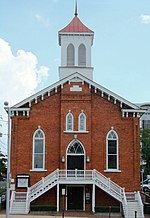
The First White House of the Confederacy is a historic house in Montgomery, Alabama, which was the initial executive residence of President of the Confederate States of America Jefferson Davis and family during early 1861. Moved from its original location in 1919 and completely furnished with original period pieces from the 1850s and 1860s, the 1835 Italianate-style house is open to the public. It has been listed on the National Register of Historic Places since 1974 and the Alabama Register of Landmarks and Heritage since 2012.

Excerpt from the Wikipedia article First White House of the Confederacy (License: CC BY-SA 3.0, Authors, Images).

First White House of the Confederacy
South Union Street, Montgomery

Geographical coordinates (GPS) Address External links Nearby Places
placeShow on map

Wikipedia: First White House of the ConfederacyContinue reading on Wikipedia

Geographical coordinates (GPS)

Latitude Longitude
N 32.376111111111 ° E -86.3 °
placeShow on map

Address

First White House of the Confederacy

South Union Street
36104 Montgomery
Alabama, United States
mapOpen on Google Maps

linkWikiData (Q5454078)
linkOpenStreetMap (128681693)

First White House of the Confederacy, Montgomery, North view 20160713 1
Share experience

Nearby Places

Alabama State Capitol

The Alabama State Capitol, listed on the National Register of Historic Places as the First Confederate Capitol, is the state capitol building for Alabama. Located on Capitol Hill, originally Goat Hill, in Montgomery, it was declared a National Historic Landmark on December 19, 1960. Unlike every other state capitol, the Alabama Legislature does not meet there, but at the Alabama State House. The Capitol has the governor's office and otherwise functions as a museum.Alabama has had five political capitals and four purpose-built capitol buildings during its history since it was designated as a territory of the United States. The first was the territorial capital in St. Stephens in 1817; the state organizing convention was held in Huntsville in 1819, and the first permanent capital was designated in 1820 as Cahaba. The legislature moved the capital to Tuscaloosa in 1826, where it was housed in a new three-story building. The 1826 State House in Tuscaloosa was later used as Alabama Central Female College. After it burned in 1923, the ruins were retained within Capitol Park. Finally, in 1846, the capital was moved again, when Montgomery was designated. The first capitol building in Montgomery, located where the current building stands, burned after two years. The current building was completed in 1851, and additional wings were added over the course of the following 140 years. These changes followed population growth in the state as many slave-holding European-American settlers arrived. Large parts of the state were subsequently developed for cotton cultivation. The current capitol building temporarily served as the Confederate Capitol while Montgomery served as the first political capital of the Confederate States of America in 1861, before Richmond, Virginia was designated as the capital. Delegates meeting as the Montgomery Convention in the Senate Chamber drew up the Provisional Constitution of the Confederate States on February 4, 1861. The convention also adopted the Permanent Constitution here on March 11, 1861.In 1965, more than one hundred years later, the third (and final) Selma to Montgomery march ended at the front marble staircase of the Capitol, with the protests and events surrounding them directly leading to the Voting Rights Act of 1965.