place

Sniper Alley

Siege of SarajevoSniper warfare tactics
Hirlimann sarajevo snipper alley

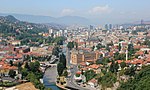
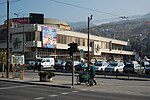
"Sniper Alley" (Serbo-Croatian: Snajperska aleja / Снајперска алеја) was the informal name primarily for streets such as Ulica Zmaja od Bosne (Dragon of Bosnia Street) and Meša Selimović Boulevard, the main boulevard in Sarajevo which during the Bosnian War was lined with Serbian snipers' posts, and became infamous as a dangerous place for civilians to traverse. The road connects the industrial part of the city (and further on, Sarajevo Airport) to the Old Town's cultural and historic sites. The boulevard itself has many high-rise buildings giving sniper shooters extensive fields of fire.Mountains surrounding the city were also used for sniper positions, providing a safe distance and giving an excellent view of the city and its traffic. Although the city was under constant Serb siege, its people still had to move about the city in order to survive, thus routinely risking their lives. Signs reading "Pazi – Snajper!" ("Watch out – Sniper!") became common. People would either run fast across the street or would wait for United Nations armored vehicles and walk behind them, using them as protective shields. According to data gathered in 1995, the snipers wounded 1,030 people and killed 225 - 60 of whom were children.

Excerpt from the Wikipedia article Sniper Alley (License: CC BY-SA 3.0, Authors, Images).

Sniper Alley
Hamze Hume, Sarajevo Skenderija (Centar Municipality)

Geographical coordinates (GPS) Address Nearby Places
placeShow on map

Wikipedia: Sniper AlleyContinue reading on Wikipedia

Geographical coordinates (GPS)

Latitude Longitude
N 43.856 ° E 18.413 °
placeShow on map

Address

Skenderija most

Hamze Hume
71144 Sarajevo, Skenderija (Centar Municipality)
Federation of Bosnia and Herzegovina, Bosnia and Herzegovina
mapOpen on Google Maps

Hirlimann sarajevo snipper alley
Share experience

Nearby Places

Sarajevo
Sarajevo

Sarajevo ( SARR-ə-YAY-voh; Cyrillic: Сарајево, pronounced [sǎrajeʋo] ; see names in other languages) is the capital and largest city of Bosnia and Herzegovina, with a population of 275,524 in its administrative limits. The Sarajevo metropolitan area including Sarajevo Canton, East Sarajevo and nearby municipalities is home to 555,210 inhabitants. Located within the greater Sarajevo valley of Bosnia, it is surrounded by the Dinaric Alps and situated along the Miljacka River in the heart of the Balkans, a region of Southern Europe. Sarajevo is the political, financial, social and cultural center of Bosnia and Herzegovina and a prominent center of culture in the Balkans. It exerts region-wide influence in entertainment, media, fashion and the arts. Due to its long history of religious and cultural diversity, Sarajevo is sometimes called the "Jerusalem of Europe" or "Jerusalem of the Balkans". It is one of a few major European cities to have a mosque, Catholic church, Eastern Orthodox church, and synagogue within the same neighborhood.Although there is evidence of human settlement in the area since prehistoric times, the modern city arose in the 15th century as an Ottoman stronghold when the latter empire extended into Europe. Sarajevo has gained international renown several times throughout its history. In 1885, it was the first city in Europe and the second city in the world to have a full-time electric tram network running through the city, following San Francisco. In 1914, it was the site of the assassination of Archduke Franz Ferdinand by a local Young Bosnia activist Gavrilo Princip, a murder that sparked World War I. This resulted in the end of Austro-Hungarian rule in Bosnia and the creation of the multicultural Kingdom of Yugoslavia in the Balkan region. Later, after World War II, the area was designated the capital of the communist Socialist Republic of Bosnia and Herzegovina within the Socialist Federal Republic of Yugoslavia, leading to rapid expansion of its population and businesses with investment in infrastructure and economic development. In 1984, Sarajevo hosted the 1984 Winter Olympics, which marked a prosperous era for the city. However, after the start of the Yugoslav Wars, the city suffered the longest siege of a capital city in the history of modern warfare, for a total of 1,425 days, from April 1992 to February 1996, during the Bosnian War. With continued post-war reconstruction in the aftermath, Sarajevo is the fastest growing city in Bosnia and Herzegovina. The travel guide series Lonely Planet ranked Sarajevo as the 43rd best city in the world. In December 2009, it recommended Sarajevo as one of the top ten cities to visit in 2010.In 2011, Sarajevo was nominated as the 2014 European Capital of Culture. It was selected to host the European Youth Olympic Festival. In addition, in October 2019, Sarajevo was designated as a UNESCO Creative City for having placed culture at the center of its development strategies. It is also ranked as one of the world's eighteen Cities of Film.