place

Invasion of Isle de France

1810 in MauritiusAttacks in MauritiusCommons category link is locally definedConflicts in 1810December 1810 events
Invasions by the United KingdomIsle de France (Mauritius)Military history of MauritiusNaval battles of the Napoleonic WarsNovember 1810 eventsWars involving Mauritius
Isle of France, 2 December 1810

The Invasion of Isle de France was a complicated but successful British amphibious operation in the Indian Ocean, launched in November 1810 during the Napoleonic Wars. During the operation, a substantial military force was landed by the Royal Navy at Grand Baie, on the French colony of Isle de France (now Mauritius). Marching inland against weak French opposition, the British force was able to overwhelm the defenders in a series of minor engagements, culminating in the capture of the island's capital Port Napoleon and the surrender of Charles Decaen, the French governor. The surrender eliminated the last French territory in the Indian Ocean and among the military equipment captured were five French Navy frigates and 209 heavy cannon. Isle de France was retained by Britain at the end of the war under the name of Mauritius and remained part of the British Empire until 1968.

Excerpt from the Wikipedia article Invasion of Isle de France (License: CC BY-SA 3.0, Authors, Images).

Invasion of Isle de France
Saint Martin Street, Port Louis Roche Bois

Geographical coordinates (GPS) Address Nearby Places
placeShow on map

Wikipedia: Invasion of Isle de FranceContinue reading on Wikipedia

Geographical coordinates (GPS)

Latitude Longitude
N -20.15 ° E 57.51 °
placeShow on map

Address

Saint Martin Street

Saint Martin Street
11703 Port Louis, Roche Bois
Port Louis, Mauritius
mapOpen on Google Maps

Isle of France, 2 December 1810
Share experience

Nearby Places

Aapravasi Ghat
Aapravasi Ghat

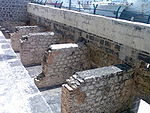
The Immigration Depot (Hindi: आप्रवासी घाट, ISO: Āpravāsī Ghāta) is a building complex located in Port Louis on the Indian Ocean island of Mauritius, the first British colony to receive indentured, or contracted, labour workforce from many countries. From 1849 to 1923, half a million Indian indentured labourers passed through the Immigration Depot, to be transported to plantations throughout the British Empire. The large-scale migration of the labourers left an indelible mark on the societies of many former British colonies, with Indians constituting a substantial proportion of their national populations. In Mauritius alone, 68 percent of the current total population is of Indian ancestry. The Immigration Depot has thus become an important reference point in the history and cultural identity of Mauritius. Unchecked infrastructural development in the mid-20th century means that only the partial remains of three stone buildings from the entire complex have survived. These are now protected as a national monument, under the Mauritian national heritage legislation. The Immigration Depot's role in social history was recognized by UNESCO when it was declared a World Heritage Site in 2006. The site is under the management of the Aapravasi Ghat Trust Fund. Conservation efforts are underway to restore the fragile buildings to their 1860s state. It is one of two World Heritage Sites in Mauritius, along with Le Morne Brabant.