place

Roman Catholic Diocese of Port-Louis

1837 establishments in MauritiusReligion in Port LouisReligious organizations established in 1837Roman Catholic dioceses and prelatures established in the 19th centuryRoman Catholic dioceses in Mauritius
Cathedral St Louis Port Louis

The Diocese of Port-Louis (Latin: Portus Ludovici; French: Diocèse de Port-Louis) is a Latin Church ecclesiastical territory or diocese of the Catholic Church located in the city of Port Louis, the capital city of Mauritius.

Excerpt from the Wikipedia article Roman Catholic Diocese of Port-Louis (License: CC BY-SA 3.0, Authors, Images).

Roman Catholic Diocese of Port-Louis
Dauphine Street, Port Louis Plaine Verte

Geographical coordinates (GPS) Address Nearby Places
placeShow on map

Wikipedia: Roman Catholic Diocese of Port-LouisContinue reading on Wikipedia

Geographical coordinates (GPS)

Latitude Longitude
N -20.1640937 ° E 57.5068831 °
placeShow on map

Address

Dauphine Street

Dauphine Street
28408 Port Louis, Plaine Verte
Port Louis, Mauritius
mapOpen on Google Maps

Cathedral St Louis Port Louis
Share experience

Nearby Places

Champ de Mars Racecourse

The Champ de Mars Racecourse (French: Hippodrome du Champ de Mars) is a thoroughbred horse race track in Port Louis, Mauritius. The Racecourse was inaugurated on 25 June 1812, by The Mauritius Turf Club (MTC) which was founded earlier the same year by Edward Alured Draper, who served in different capacities, namely as Chief of Police, Colonial Secretary, Collector of Customs, Civil engineer, Registrar of Slaves, Magistrate and Colonial Treasurer. The Mauritius Turf Club is the oldest horse-racing club in the Southern Hemisphere and the second oldest in the world. The race track follows a very selective right hand oval path and is relatively small in size, with a circumference of 1,298 meters (4,258.5 ft) and width between 12 and 14 meters (39 and 46 feet). The home-straight extends uphill and is 225 meters (738 ft) long. When Mauritius gained independence on 12 March 1968, the event including the flag hoisting ceremony was held here. Since then and for many years, the racecourse has seen the annual celebration of the accession to independence. Today, the Champ de Mars attracts tens of thousands of people on each racing day during the racing season from late March to early December and has become the ultimate meeting place for racing fanatics from all over the island and even from abroad. The track has also played a fundamental role in propelling horse racing as the most popular sport and form of entertainment among the local population.

Aapravasi Ghat
Aapravasi Ghat

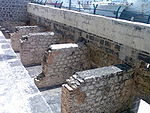
The Immigration Depot (Hindi: आप्रवासी घाट, ISO: Āpravāsī Ghāta) is a building complex located in Port Louis on the Indian Ocean island of Mauritius, the first British colony to receive indentured, or contracted, labour workforce from many countries. From 1849 to 1923, half a million Indian indentured labourers passed through the Immigration Depot, to be transported to plantations throughout the British Empire. The large-scale migration of the labourers left an indelible mark on the societies of many former British colonies, with Indians constituting a substantial proportion of their national populations. In Mauritius alone, 68 percent of the current total population is of Indian ancestry. The Immigration Depot has thus become an important reference point in the history and cultural identity of Mauritius. Unchecked infrastructural development in the mid-20th century means that only the partial remains of three stone buildings from the entire complex have survived. These are now protected as a national monument, under the Mauritian national heritage legislation. The Immigration Depot's role in social history was recognized by UNESCO when it was declared a World Heritage Site in 2006. The site is under the management of the Aapravasi Ghat Trust Fund. Conservation efforts are underway to restore the fragile buildings to their 1860s state. It is one of two World Heritage Sites in Mauritius, along with Le Morne Brabant.