place

Bely Gorod

16th century in MoscowCultural heritage monuments of federal significance in MoscowGeography of MoscowMoscow geography stubsRussian history stubs
Bely gorod на карте Москвы Меттеуса Мериана

Bely Gorod (Russian: Бе́лый го́род, IPA: [ˈbʲelɨj ˈɡorət], "White City") is the central core area of Moscow, Russia beyond the Kremlin and Kitay-gorod. The name comes from the color of its defensive wall, which was erected in 1585–1593 at the behest of tsar Feodor I and Boris Godunov by architect Fyodor Kon'. The wall is 10 kilometers (6.2 mi) in length, and its width ranges up to 4.5 meters (15 ft) at its widest. Bely Gorod had 28 towers and 11 gates, the names of some of which are still preserved in the names of squares, namely: Trehsvyatsky, Chertolsky (Prechistensky), Arbatsky, Nikitsky, Tversky, Petrovsky, Sretensky, Myasnitsky, Pokrovsky, Yauzskiy, Vasilievsky. The walls were cogged, like the Kremlin walls, with loopholes that allowed keeping a continuous fire. During the reign of Catherine the Great and her grandson Alexander I the wall was demolished and replaced by a chain of boulevards, known as the Boulevard Ring.

Excerpt from the Wikipedia article Bely Gorod (License: CC BY-SA 3.0, Authors, Images).

Bely Gorod
улица Варварка, Moscow Tverskoy District

Geographical coordinates (GPS) Address Nearby Places
placeShow on map

Wikipedia: Bely GorodContinue reading on Wikipedia

Geographical coordinates (GPS)

Latitude Longitude
N 55.751111111111 ° E 37.628333333333 °
placeShow on map

Address

Парк "Зарядье"

улица Варварка вл6
109012 Moscow, Tverskoy District
Moscow, Russia
mapOpen on Google Maps

Bely gorod на карте Москвы Меттеуса Мериана
Share experience

Nearby Places

Moscow Gostiny Dvor
Moscow Gostiny Dvor

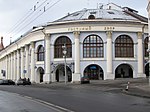
The Old Merchant Court (Russian: Старый гостиный двор, Stary gostiny dvor) in Moscow occupies a substantial portion of Kitai-gorod, as the old merchant district is known. It located near the famous Red Square, a few hundred metres away. Formerly accommodating both shops and warehouses, it was constructed of brick in the 1590s and underwent significant modifications from 1638–1641. As the Russian capital expanded and the old structure became overcrowded, a new indoor market was completed nearby in 1665. Giacomo Quarenghi, the favored architect of Catherine the Great, in 1789 replaced those medieval buildings with a new shopping mall designed in a sober Neoclassical style with innumerable Corinthian columns and arcades. Several local Moscow architects including S. Karin, I. Egotov and P. Selihov supervised the actual construction. The first phase was delayed because of the death of Catherine the Great and was not completed until 1805. Osip Bove made some modifications to adapt to the slope in the area and to finish following Quarenghi's original plans in 1830.Subsequently, Quarenghi's structure went through many reconstructions. After the Revolution in 1923, the space was subdivided into offices altering the original design significantly. In 1995 a modern glass roof was installed, when the building was being converted into a fashionable exhibition ground. Nowadays, the edifice is used as the setting for fashion shows, business parties, and even Viennese balls. Montserrat Caballé and José Carreras were among those who performed at the New Year parties in Gostiny Dvor.During the 1995 renovations, much archeological work was done on the site. A small museum was established to exhibit some of the numerous finds which include the contents of a pantry from a 17th-century merchant home that had been destroyed by fire. The exhibit hall is open for the public, Monday through Saturday from 11 a.m. until 5 p.m.

2023 Presidential Address to the Federal Assembly

On 21 February 2023, almost a year after Russia launched a full-scale invasion of Ukraine, Russian president Vladimir Putin delivered an address to the Federal Assembly, at Gostiny Dvor in Moscow, Russia. This was the first Presidential Address to the Federal Assembly since the start of the invasion; Putin did not deliver such an address in 2022.During the address, Putin asserted that the West had started the war, and that Russia had been using force to end it. He stated that the Ukrainian people were hostages of the Ukrainian government. Putin also said that the West had planned to turn a local conflict into a global one, and that the conflict represented an existential threat to Russia. He added that it was impossible to defeat Russia, and vowed to continue fighting in Ukraine. He also praised the people of Luhansk, Donetsk, Kherson, and Zaporizhzhia for the choice they made during the previous year's annexation referendums. Near the end of his speech, Putin announced that Russia would be suspending its participation in the nuclear disarmament treaty New START.Putin's address was simultaneously broadcast on television and in schools and government buildings, as well as displayed on large screens in public places in Russia and the occupied territories of Ukraine. It was delivered a day after U.S. president Joe Biden had made a surprise visit to Kyiv, his first to Ukraine since the start of the invasion. Biden also delivered a speech in Warsaw, Poland, hours after Putin had made his presidential address. The following day, Putin made a brief appearance at a rally at Luzhniki Stadium in Moscow commemorating Defender of the Fatherland Day.