place

Estadio Azteca

1966 establishments in Mexico1970 FIFA World Cup stadiums1986 FIFA World Cup stadiums1999 FIFA Confederations Cup stadiums2026 FIFA World Cup Stadiums
American Bowl venuesAmerican football venues in MexicoCONCACAF Gold Cup stadiumsClub AméricaFootball venues in MexicoNational Football League venuesNational stadiumsOlympic football venuesPan American Games opening ceremony stadiumsSports venues completed in 1966Sports venues in Mexico CityStadiums that have hosted a FIFA World Cup opening matchTlalpanVenues of the 1968 Summer Olympics
Sobrevuelos CDMX IMG 5971 (25513748117)

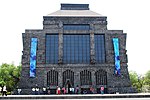
Estadio Azteca (American Spanish: [esˈtaðjo asˈteka]) is a multi-purpose stadium located in Mexico City. It is the official home of football clubs Club América and Cruz Azul, as well as the Mexico national team. The stadium sits at an altitude of 2,200 m (7,200 feet) above sea level. With a capacity of 87,523, it is the largest stadium in Mexico and Latin America and the eighth largest association football stadium in the world. Regarded as one of the most famous and iconic football stadiums in the world, it is the first to have hosted two FIFA World Cup Finals; the 1970 World Cup Final, where Brazil defeated Italy 4–1, and the 1986 World Cup Final, where Argentina defeated West Germany 3–2. It also hosted the 1986 quarter-final match between Argentina and England in which Diego Maradona scored both the "Hand of God goal" and the "Goal of the Century". The Estadio Azteca is the only football stadium in the world to have both Pelé (1970) and Diego Maradona (1986) win the FIFA World Cup, both of whom are considered among the greatest football players of all time. The stadium also hosted the "Game of the Century", when Italy defeated West Germany 4–3 in extra time in one of the 1970 semifinal matches. The stadium was also the principal venue for the football tournament of the 1968 Summer Olympics and the 1971 Women's World Cup. The stadium is scheduled to host games during the 2026 FIFA World Cup, making it the only stadium to host three editions of the FIFA World Cup.Additionally, the National Football League (NFL) features one game at Estadio Azteca per season as a part of its International Series.

Excerpt from the Wikipedia article Estadio Azteca (License: CC BY-SA 3.0, Authors, Images).

Estadio Azteca
Circuito Estadio Azteca, Mexico City

Geographical coordinates (GPS) Address External links Nearby Places
placeShow on map

Wikipedia: Estadio AztecaContinue reading on Wikipedia

Geographical coordinates (GPS)

Latitude Longitude
N 19.303055555556 ° E -99.150555555556 °
placeShow on map

Address

Estadio Azteca

Circuito Estadio Azteca
04650 Mexico City
Mexico
mapOpen on Google Maps

linkWikiData (Q320454)
linkOpenStreetMap (4758704)

Sobrevuelos CDMX IMG 5971 (25513748117)
Share experience

Nearby Places

Anahuacalli Museum
Anahuacalli Museum

The Diego Rivera Anahuacalli Museum is a museum and arts center in Mexico City, located in the San Pablo de Tepetlapa neighborhood of Coyoacán, 10 minutes by car from the Frida Kahlo Museum, as well as from the tourist neighborhood of this district. The Anahuacalli (from the Nahuatl word, whose meaning is "house surrounded by water"), is a temple of the arts designed by the Mexican muralist Diego Rivera. This museum stands out for its extensive collection of pre-Columbian art, as well as for its Ecological Space that protects endemic flora and fauna. Rivera designed its architecture in order to safeguard his vast collection of pre-Hispanic pieces, while exhibiting the most beautiful works of this set in the museum's main building. Accordingly, a selection of 2,000 artworks, especially well executed and preserved, has been on display since the opening of the Anahuacalli to the public on September 18, 1964. The extravagant architecture of the building is inspired by Mesoamerican structures, with a unique style of its kind that mixes Mayan and Toltec influences mainly, although Rivera himself defined it as an amalgamation of Aztec, Mayan and "Traditional Rivera" styles. The Anahuacalli Museum building is erected with carved volcanic stone, extracted from the same place where it stands. According to the words of the Tabasco museographer and poet Carlos Pellicer, who designed the museum's permanent exhibition at the express indication of Rivera himself, the Anahuacalli responds to the following description: "It is a personal creation using pre-Hispanic elements, mainly from Toltec architecture and some of the Mayan: sloped walls, serpentine pilasters and rhomboid doors. The pyramidal crown accentuates the magnificent character of the building. The flat ceilings on the ground floor and the upper floors are decorated with original mosaics by the great painter, which are elements that are integrated into the architecture. The ground floor is occupied by Aztec and the Teotihuacan artworks. A beautiful group of stone sculptures, clay figurines -models of temples- and pottery utensils." Diego Rivera planned the Anahuacalli as a great stage for the development of diverse artistic expressions such as theater, dance, painting and music. These disciplines are immersed in an atmosphere whose architecture represents the search for the Mexican essence through its rich pre-Columbian past. At the same time, the Anahuacalli is integrated into the artistic, intellectual and educational events of contemporary times. Every year, in compliance with the will that Rivera expressed for the Anahuacalli, contemporary art exhibitions are presented on the premises. These proposals are carefully chosen, as they must alternate harmoniously with the museum's architecture, with the pre-Columbian art on display, with the nature that surrounds it, and with the foundational and evolving concept of Diego's Anahuacalli. The Anahuacalli is a testimony to Rivera's generosity; he created a prodigious architectural work to display his collection of pre-Hispanic art with the people of Mexico and the world. Thanks to this museum, today, thousands of national and foreign visitors can delve into the creative universe that the muralist left housed in this unique place. Everyone who visits the site can enjoy its natural and architectural spaces, as well as the rich collection of Mesoamerican art bequeathed to Mexico, by Master Rivera.

Universidad Autónoma Metropolitana

The Metropolitan Autonomous University (Spanish: Universidad Autónoma Metropolitana) also known as UAM, is a Mexican public university. Founded in 1974 with the support of then-President Luis Echeverria Alvarez, the institution aims to be closely linked to the social and human environment.As an autonomous university, UAM is a public agency of the Mexican government. It has five academic units located in Mexico City and Greater Mexico City: Azcapotzalco, in north, Iztapalapa, in east, Cuajimalpa, in west, Xochimilco, in south, and Lerma in State of Mexico.), The institution is among the top academic universities in Mexico. In 2019, it ranked first among both public and private institution, was second in the number of full-time research professors with doctorates, according to the Comparative Study of Mexican Universities (Estudio Comparativo de Universidades Mexicanas); having the second largest number of built in National and Research System (Sistema Nacional de Investigadores) the second in having researchers at Level 3 of the same researchers. One of the leading universities in Mexico to submit the highest number of research. And the second institution to have publications in refereed journals, such as the Institute for Scientific Information, Latindex and journals included in the Index of Mexican Journals of Scientific and Technological Research of the National Council of Science and Technology (Consejo Nacional de Ciencia y Tecnología) and the second to have magazines within the Conacyt, it is also among the top four with the largest number of patents granted in Mexico.