place

Serebryanka (Moscow)

Moscow geography stubsRivers of MoscowRivers of Moscow OblastRussia river stubsTributaries of the Moskva
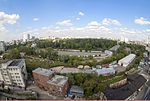
Serebrjanka River (Izmailovo Park, Moscow)

Serebryanka (Izmaylovka in a past - Robka) is a river in the north-east of Moscow, left tributary of Khapilovka, in turn a tributary of the Yauza.

Excerpt from the Wikipedia article Serebryanka (Moscow) (License: CC BY-SA 3.0, Authors, Images).

Serebryanka (Moscow)
Ветка Черкизово - Электрозавод, Moscow Cherkizovo

Geographical coordinates (GPS) Address Nearby Places
placeShow on map

Wikipedia: Serebryanka (Moscow)Continue reading on Wikipedia

Geographical coordinates (GPS)

Latitude Longitude
N 55.794166666667 ° E 37.734166666667 °
placeShow on map

Address

Ветка Черкизово - Электрозавод
105318 Moscow, Cherkizovo
Moscow, Russia
mapOpen on Google Maps

Serebrjanka River (Izmailovo Park, Moscow)
Share experience

Nearby Places

Preobrazhenskoye Cemetery

Preobrazhenskoye Cemetery (Russian: Преображенское кладбище, lit. Transfiguration Cemetery) is a cemetery in the eastern part of Moscow long associated with Old Believers. It was inaugurated by a Fedoseevtsy merchant in 1777 as a plague quarantine disguising the Bespopovtsy monastery. At that time the territory of the cemetery was located outside Moscow, but near its border. The cemetery soon became the spiritual and administrative center of all the Fedoseevtsy in Russia (just like the Rogozhskoe cemetery became an administrative and cultural centre for most Popovtsy Old Believers). The cloister consisted of two equal square areas, a monastery for men and a nunnery for women, separated by a road to the cemetery. Construction work was in progress throughout the 1790s and the first decade of the 19th century. At that time, the monastery asylum was home to 1,500 people, while the chapels were attended by as many as 10,000 Old Believers. Every church within the monastery was styled a chapel; like other Bespopovtsy, the Fedoseevtsy reject priesthood, and so even their largest temples are called chapels rather than churches, since they have no altar. The area was surrounded by brick walls with decorative pseudo-gothic towers. In the mid-19th century the "male" part of the monastery was confiscated from the Fedoseevtsy by the imperial administration to be transformed into the monastery of the Edinovertsy, the only legal denomination of Old Believers in Imperial Russia. The cloister, which came to be known as the St Nicholas Monastery of the Edinovertsy, boasted the largest collection of Old Believer literature (the Khludov bequest) and as many as 1,300 ancient icons. After the October Revolution the St. Nicholas Monastery was occupied by the Obnovlentsy, while the icons and the books were taken to the State Historical Museum and the Tretyakov Gallery. Later the monastery was divided between the Pomortsy Old Believers and the nearby parish of the official Russian Orthodox Church. The orthodox parish took a church above the gates with surrounding quarters, a bell-tower and a western part of the temple. The eastern part of the temple and several utilities in the western part of the territory belong to Pomortsy. The two parts of a single temple are currently separated by a thick brick wall, and compartments are occupied by different denominations. The women's part of Preobrazhenka avoided such a dissension, and still belongs to the Fedoseevtsy. The cemetery is also noted as a place where the first Eternal flame in Moscow was kindled in order to commemorate the World War II dead.

Partizanskaya (Moscow Metro)

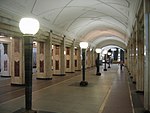
Partizanskaya (Russian: Партизанская, IPA: [pərtʲɪˈzanskəjə]), known until 2005 as Izmailovsky Park (Измайловский парк), is a station on the Arbatsko-Pokrovskaya Line of the Moscow Metro. It was built during World War II, opened in 1944 and is dedicated to the Soviet partisans who resisted the Nazis. The name was changed on the 60th anniversary of the Soviet victory to reflect the theme of the station better. The station's design was the work of the architect Vilenskiy. Partizanskaya is an unusual three-track layout, with two island platforms. The rarelt-used centre track was built to handle crowds from a nearby stadium that was planned but never built because of the war. There is one row of pillars per platform. Both the walls and pillars of the station are faced with white marble and decorated with bas-reliefs honouring the partisans. The two pillars closest to the exit stairs are adorned with statues: Zoya Kosmodemyanskaya on the left and Matvey Kuzmin on the right. The circular ceiling niche at the foot of the stairs originally contained a fresco by A.D. Goncharov, but it has since been painted over. At the top of the stairs is a sculptural group by Matvey Manizer entitled "Partisans" and bearing the inscription "To partisans and partisan glory!". Station's original name was "Izmailovsky park kul'tury i otdyha imeni Stalina" (English: Stalin Ismailovsky Park of Culture and Leisure). It was changed to "Izmailovskaya" in 1948. In 1961, new station, named "Izmailovsky Park" at the time of its opening, was introduced. And in 1963, names of stations "Izmailovskaya" and "Izmailovsky Park" were switched, reason being which station was closer to the actual park's main entrance. The 2005's rename to "Partizanskaya" has been mentioned in the open letter of a resigning Moscow's toponymy commission member, as one of a number of then-recent renames with political causes rather than the historical toponymy upholding ones.