place

Jefferson Township, Newton County, Indiana

Northwest Indiana geography stubsTownships in IndianaTownships in Newton County, IndianaUse mdy dates from July 2023
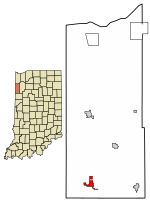
Map highlighting Jefferson Township, Newton County, Indiana

Jefferson Township is one of ten townships in Newton County, Indiana. As of the 2010 census, its population was 2,140 and it contained 964 housing units.

Excerpt from the Wikipedia article Jefferson Township, Newton County, Indiana (License: CC BY-SA 3.0, Authors, Images).

Jefferson Township, Newton County, Indiana
North 1st Street,

Geographical coordinates (GPS) Address Nearby Places
placeShow on map

Wikipedia: Jefferson Township, Newton County, IndianaContinue reading on Wikipedia

Geographical coordinates (GPS)

Latitude Longitude
N 40.779722222222 ° E -87.448888888889 °
placeShow on map

Address

North 1st Street 974
47951
Indiana, United States
mapOpen on Google Maps

Map highlighting Jefferson Township, Newton County, Indiana
Share experience

Nearby Places

Kentland crater
Kentland crater

The Kentland structure, also known as the Kentland crater or the Kentland disturbed area, is an impact structure located near the town of Kentland in Newton County, Indiana, United States.It was discovered about 1880 when two farmers began to quarry crushed rock there. The presence of shatter cones and deformed bedrock led geologists to conclude by the late 1960s that the Kentland structure is a deeply eroded impact structure, rather than volcanic in origin. Deformation at the site is so great that vertical contacts between normally horizontal rock formations of different ages are common. The structure itself is a circular dome, about 7.24 km (4.50 mi) in diameter, deeply eroded and buried in glacial debris. Its age is estimated to be less than 97 million years (Cretaceous or younger). The Shakopee dolomite at the center of the structure is about 450 million years old (Ordovician period) and is uplifted about 2,000 feet higher than the level of the same rock in the surrounding area. The entire disturbed area is about 13 km (8.1 mi) in diameter. The estimated age is in dispute. ‘"97 MYA‘" Late Cretaceous Period of the Mesozoic Era ‘"300 MYA‘= Bzhelian or Late Pennsylvanian Epoch (Carboniferous Period) of the Paleozoic EraThis impact structure was studied in 1978. John Weber and his associates presented fission track dating of apatite from this impact structure. Coesite and shatter cones are found in the uplift near its center. The impact structure is exposed to the surface, resulting in erosion. It is currently being worked as a quarry.