place

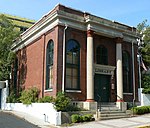
Tallahassee Female Academy

1843 establishments in Florida Territory1858 disestablishments in FloridaDefunct universities and colleges in FloridaEducation in Tallahassee, FloridaEducational institutions disestablished in 1858
Educational institutions established in 1843Female seminaries in the United StatesFlorida State UniversityPublic universities and colleges in Florida
Tallahassee Female Academy rc01133

The Tallahassee Female Academy (also known as the Leon Female Academy) was one of the predecessor institutions of Florida State University in Tallahassee, Florida. The school started in 1843 as the Misses Bates School and was perhaps the most stable educational institution in Tallahassee until the West Florida Seminary officially began operations in 1857. They were remedies for the fact that at the time there were no public high schools in Florida. Male and female students studied separately. A group of Tallahassee citizens organized as a board of trustees for the academy conducted operations until the school was absorbed by the West Florida Seminary in 1858. The school offered an unusually complete education for the time.

Excerpt from the Wikipedia article Tallahassee Female Academy (License: CC BY-SA 3.0, Authors, Images).

Tallahassee Female Academy
West Park Avenue, Tallahassee

Geographical coordinates (GPS) Address Nearby Places
placeShow on map

Wikipedia: Tallahassee Female AcademyContinue reading on Wikipedia

Geographical coordinates (GPS)

Latitude Longitude
N 30.4418 ° E -84.2837 °
placeShow on map

Address

West Park Avenue 207
32301 Tallahassee
Florida, United States
mapOpen on Google Maps

Tallahassee Female Academy rc01133
Share experience

Nearby Places

First Presbyterian Church (Tallahassee, Florida)

First Presbyterian Church is an historic church in Tallahassee, Florida. It is located at 102 North Adams Street. The congregation was first organized on November 4, 1832, and the church building was built between 1835 and 1838, which makes it the oldest church in Tallahassee and the oldest building in Florida that's still being used for its original purpose. The building was designed to serve as a sanctuary for women and children during American Indian attacks. Rifle slots are built into the foundation but are not visible from outside. On September 9, 1974, it was added to the U.S. National Register of Historic Places.Today, there are still services every Sunday at 11:00 A.M.There are estimated to be several hundred members of the congregation, with average attendance of just over two hundred persons. The congregation is part of the Presbyterian Church (USA), and is known for having and maintaining a progressive theological and social perspective through the years. Since 2008, First Presbyterian Church has been affiliated with The Covenant Network of Presbyterians, and supports the ordination of all qualified persons into both lay and ordained ministry, regardless of sexual orientation. For the past several years, First Presbyterian Church has been a sponsor of Pridefest. In 2009, the "Light from Light" campaign was born. As a part of this program, solar panels were added to the building, making First Presbyterian one of only a few churches nationwide to generate a portion of its own electricity. As of 2010, First Presbyterian Church was home to the second largest solar panel array in Leon County.

Joseph Hatchett United States Courthouse

The Joseph Hatchett United States Courthouse is a courthouse and U.S. federal government facility in Tallahassee, Florida. It houses: The United States District Court for the Northern District of Florida, Tallahassee Division and the United States Attorney for the Northern District of Florida which serves Franklin, Gadsden, Jefferson, Leon, Liberty, Madison, Taylor and Wakulla counties. A satellite office of the United States Court of Appeals for the Eleventh Circuit. Offices for the United States Probation and Pretrial Services System, the United States Marshals Service, and the United States Trustee Program. The courthouse was completed in 1999 at a cost of $17 million and opened that same year. It replaced the old former courthouse, which was built in 1935-1936 and now houses the United States bankruptcy court of the Northern District of Florida. The courthouse displays a mural collection by Lincoln Perry which depict moments in the evolution of our justice system. The structure comprises six courtrooms, 169,758 square feet (15,771.0 m2) over four floors, with a secure parking facility in the basement. It also includes judge's chambers, administration offices, holding cells and U.S. Marshall's offices. For safety, there is a Security Operations Data Center, detention holding areas and a sally port. It was named after Joseph W. Hatchett, a federal judge whose service broke racial barriers in the south. He was the first Black judge appointed to Florida's Supreme Court in 1975 by Florida Governor Reubin Askew. He was the first Black man in the U.S. South to be appointed to the federal appeals court in 1979 by President Jimmy Carter. At the time, the 5th circuit had jurisdiction over Alabama, Florida, Georgia, Louisiana, Mississippi, and Texas. After an act of Congress (S. 2938) passed in the U.S. House of Representatives on June 24, 2022 President Joe Biden signed the measure into law through the Bipartisan Safer Communities Act on June 25, 2022. The courthouse was officially dedicated on June 30, 2023.

Supreme Court of Florida

The Supreme Court of Florida is the highest court in the U.S. state of Florida. It consists of seven justices—one of whom serves as Chief Justice. Six members are chosen from six districts around the state to foster geographic diversity, and one is selected at large. The justices are appointed by the governor to set terms, which do not exceed six years. Immediately after appointment, the initial term is three years or less because the justices must appear on the ballot in the next general election that occurs more than one year after their appointment. Afterward, they serve six-year terms and remain in office if retained in the general election near the end of each term. Citizens vote on whether or not they want to retain each justice in office.Chief justices are elected by the members of the Court to two-year terms that end in every even-numbered year. Chief justices may succeed themselves in office if they are re-elected by the other justices. The chief justice also can appoint judges to temporary duty on the Court if at least one of the justices is unable to hear a case for any reason. The temporary justices are called "associate justices" and are usually chosen on a rotating basis from presiding judges of Florida's district courts of appeal. They usually sit only for a single case. Unlike the U.S. Supreme Court, the term "associate justice" is never used to describe the sitting Florida justices. The Court is the final arbiter of state law of Florida, and its decisions are binding authority for all other Florida state courts, as well as for federal courts when they apply Florida law. In most instances, the only appeal from the Florida Supreme Court is to the U.S. Supreme Court on questions of federal law.Established upon statehood in 1845, the Florida Supreme Court is headquartered across Duval Street from the state capitol in Tallahassee. Throughout the court's history, it has undergone many reorganizations as Florida's population has grown. As of October 2020, each justice of the Florida Supreme Court receives a salary of $227,218.