place

Louis-Hébert (provincial electoral district)

CanElecResTopTest with bare yearProvincial electoral districts of Quebec CityQuebec provincial electoral districts

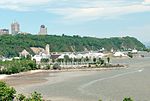
Louis-Hébert is a provincial electoral district in the Capitale-Nationale region of Quebec, Canada. It consists of part of the Sainte-Foy–Sillery–Cap-Rouge borough of Quebec City (specifically the neighbourhoods of Cap-Rouge, Champigny, Jouvence, Quartier Laurentien, Lorette, Les Grands-Déserts and parts of Pointe-de-Sainte-Foy and Place-Notre-Dame), as well as all of Saint-Augustin-de-Desmaures. It was created for the 1966 election from parts of Québec-Comté and Québec-Ouest and a small part of Portneuf electoral districts. In the change from the 2001 to the 2011 electoral map, it gained Saint-Augustin-de-Desmaures from La Peltrie; it also gained part of Quebec City from La Peltrie, but lost part of the city to Jean-Talon. The riding was named after the first legal farmer of New France, Louis Hébert.

Excerpt from the Wikipedia article Louis-Hébert (provincial electoral district) (License: CC BY-SA 3.0, Authors).

Louis-Hébert (provincial electoral district)
Rue Pouliot, Quebec Saint-Louis (Sainte-Foy–Sillery–Cap-Rouge)

Geographical coordinates (GPS) Address Nearby Places
placeShow on map

Wikipedia: Louis-Hébert (provincial electoral district)Continue reading on Wikipedia

Geographical coordinates (GPS)

Latitude Longitude
N 46.775 ° E -71.297222222222 °
placeShow on map

Address

Rue Pouliot 933
G1V 2X8 Quebec, Saint-Louis (Sainte-Foy–Sillery–Cap-Rouge)
Quebec, Canada
mapOpen on Google Maps

Share experience

Nearby Places

Quebec City mosque shooting

The Quebec City mosque shooting (French: Attentat de la grande mosquée de Québec) was a terrorist attack by 27-year-old Alexandre Bissonnette on the evening of January 29, 2017, at the Islamic Cultural Centre of Quebec City, a mosque in the Sainte-Foy neighbourhood of Quebec City, Canada. Six worshippers were killed and five others seriously injured after evening prayers when Bissonnette entered the prayer hall shortly before 8:00 pm and opened fire for about two minutes with a 9mm Glock pistol. Approximately 40 people were reported present at the time of the shooting. The perpetrator, 27-year-old Alexandre Bissonnette, pleaded guilty to six counts of first-degree murder and six counts of attempted murder. On February 8, 2019, Bissonnette was sentenced to life in prison, with no possibility of parole for 40 years. Upon appeal, the Court of Appeal of Quebec found 40 years without parole to be unconstitutionally cruel and unusual punishment, adjusting the sentence to life in prison with no possibility of parole for 25 years. Quebec prosecutors sought to reinstate the original sentence with an appeal to the Supreme Court of Canada. The decision was upheld on May 27, 2022, meaning Bissonnette will be eligible for parole in 2042.The shooting prompted widespread discussion of Islamophobia, racism, and right-wing terrorism in Canada. Prime Minister Justin Trudeau and Premier Philippe Couillard called the shooting a terrorist attack, but Bissonnette was not charged or sentenced under the terrorism provision of the Criminal Code or described as such by terrorism experts. On the fourth anniversary of the attack, the Trudeau government announced plans to commemorate the day of the attack as The National Day of Remembrance of the Quebec Mosque Attack and of Action Against Islamophobia.