place

Patriarshy Bridge

AC with 0 elementsBox girder bridgesBridges completed in 2004Bridges in MoscowEuropean bridge (structure) stubs
Russia transport stubsRussian building and structure stubs
Wiki patriarshy 1
Wiki patriarshy 1

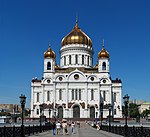
Patriarshy Bridge (Russian: Патриарший Мост/Patriarchal Bridge) is a steel pedestrian box girder bridge that spans Moskva River and Vodootvodny Canal, connecting Cathedral of Christ the Saviour with Bersenevka in downtown Moscow, Russia (0.6 kilometers west from the Kremlin). It was built in 2004, designed by Mikhail Posokhin. The second part of the bridge spanning Vodootvodny Canal was opened in September, 2007.

Excerpt from the Wikipedia article Patriarshy Bridge (License: CC BY-SA 3.0, Authors, Images).

Patriarshy Bridge
Bersenevskaya Naberezhnaya, Moscow Yakimanka District

Geographical coordinates (GPS) Address External links Nearby Places
placeShow on map

Wikipedia: Patriarshy BridgeContinue reading on Wikipedia

Geographical coordinates (GPS)

Latitude Longitude
N 55.74333 ° E 37.60889 °
placeShow on map

Address

Патриарший мост

Bersenevskaya Naberezhnaya
119072 Moscow, Yakimanka District
Moscow, Russia
mapOpen on Google Maps

linkWikiData (Q4347018)
linkOpenStreetMap (1790163)

Wiki patriarshy 1
Wiki patriarshy 1
Share experience

Nearby Places

Palace of the Soviets

The Palace of the Soviets (Russian: Дворец Советов, Dvorets Sovetov) was a project to construct a political convention center in Moscow on the site of the demolished Cathedral of Christ the Saviour. The main function of the palace was to house sessions of the Supreme Soviet in its 130-metre (430 ft) wide and 100-metre (330 ft) tall grand hall seating over 20,000 people. If built, the 416-metre (1,365 ft) tall palace would have become the world's tallest structure, with an internal volume surpassing the combined volumes of the six tallest American skyscrapers.Boris Iofan won a series of four architectural competitions held in 1931–1933 marking the beginning of a sharp turn of Soviet architecture from 1920s modernism to the monumental historicism of Stalinist architecture. The individuals behind these events and their motives remain a matter of conjecture and debate. Recent research supports the hypothesis that Iofan had been the chosen architect from the very start and manipulated the competitions to his own benefit. The definitive design by Iofan, Vladimir Shchuko and Vladimir Helfreich was conceived in 1933–1934 and took its final shape in 1937. The staggered stack of ribbed cylinders crowned with a 100-metre (330 ft) statue of Vladimir Lenin blended Art Deco and neoclassical influences with contemporary American skyscraper technology. Work on the site commenced in 1933; the foundation was completed in January 1939. The German invasion in June 1941 ended the project. Engineers and workers were diverted to defense projects or pressed in the army; the installed structural steel was disassembled in 1942 for fortifications and bridges. After World War II, Joseph Stalin lost interest in the palace. Iofan produced several revised, scaled-down designs but failed to reanimate the project. The alternative Palace of the Soviets in Sparrow Hills, which was proposed after Stalin's death, did not proceed beyond the architectural competition stage.