place

Strelka Institute

2009 establishments in RussiaArchitecture schools in RussiaArt schools in RussiaEducation in MoscowEducational institutions established in 2009
Urban planning
Strelka institute 2010

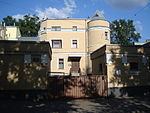
Strelka Institute for Media, Architecture and Design is a non-profit international educational project, founded in 2009 and located in Moscow. Strelka incorporates an education programme on urbanism and urban development aimed at professionals with a higher education, a public summer programme, the Strelka Press publishing house, and KB Strelka, the consulting arm of the Institute. Strelka has been listed among the top-100 best architecture schools in 2014, according to Domus magazine.The Institute has been directed since 2013 by Varvara Melnikova.

Excerpt from the Wikipedia article Strelka Institute (License: CC BY-SA 3.0, Authors, Images).

Strelka Institute
Bersenevskaya Naberezhnaya, Moscow Yakimanka District

Geographical coordinates (GPS) Address Nearby Places
placeShow on map

Wikipedia: Strelka InstituteContinue reading on Wikipedia

Geographical coordinates (GPS)

Latitude Longitude
N 55.742665 ° E 37.609086 °
placeShow on map

Address

Bersenevskaya Naberezhnaya 14 с5
119072 Moscow, Yakimanka District
Moscow, Russia
mapOpen on Google Maps

Strelka institute 2010
Share experience

Nearby Places

Palace of the Soviets

The Palace of the Soviets (Russian: Дворец Советов, Dvorets Sovetov) was a project to construct a political convention center in Moscow on the site of the demolished Cathedral of Christ the Saviour. The main function of the palace was to house sessions of the Supreme Soviet in its 130-metre (430 ft) wide and 100-metre (330 ft) tall grand hall seating over 20,000 people. If built, the 416-metre (1,365 ft) tall palace would have become the world's tallest structure, with an internal volume surpassing the combined volumes of the six tallest American skyscrapers.Boris Iofan won a series of four architectural competitions held in 1931–1933 marking the beginning of a sharp turn of Soviet architecture from 1920s modernism to the monumental historicism of Stalinist architecture. The individuals behind these events and their motives remain a matter of conjecture and debate. Recent research supports the hypothesis that Iofan had been the chosen architect from the very start and manipulated the competitions to his own benefit. The definitive design by Iofan, Vladimir Shchuko and Vladimir Helfreich was conceived in 1933–1934 and took its final shape in 1937. The staggered stack of ribbed cylinders crowned with a 100-metre (330 ft) statue of Vladimir Lenin blended Art Deco and neoclassical influences with contemporary American skyscraper technology. Work on the site commenced in 1933; the foundation was completed in January 1939. The German invasion in June 1941 ended the project. Engineers and workers were diverted to defense projects or pressed in the army; the installed structural steel was disassembled in 1942 for fortifications and bridges. After World War II, Joseph Stalin lost interest in the palace. Iofan produced several revised, scaled-down designs but failed to reanimate the project. The alternative Palace of the Soviets in Sparrow Hills, which was proposed after Stalin's death, did not proceed beyond the architectural competition stage.

Russian International Affairs Council

The Russian International Affairs Council (RIAC, Russian: Российский совет по международным делам) is a non-profit academic and diplomatic think tank established by the presidential decree dated 2 February 2010. The founders of the RIAC are the Ministry of Foreign Affairs of the Russian Federation, Ministry of Education and Science, Russian Academy of Science, the Russian Union of Industrialists and Entrepreneurs and Russian news agency Interfax. The Russian International Affairs Council was founded on orders of then-President Dmitry Medvedev to contribute to Russia's soft power efforts.The RIAC activities are aimed at strengthening peace, friendship and solidarity between peoples, preventing international conflicts and promoting conflict resolution and crisis settlement. It operates as a link between the state, scholar community, business, and civil society in an effort to find foreign policy solutions to current international issues. The RIAC is one of Russia's public diplomacy tools. The RIAC mission is to facilitate Russia's peaceful integration into the global community, partly through greater cooperation between Russian scientific institutions and foreign think tanks/scholars on major international issues. The council's strategic mission is to facilitate communication between government officials and the expert, business and civil communities when elaborating foreign policy decisions.