place

Moskva Pool

Buildings and structures built in the Soviet UnionBuildings and structures in MoscowDefunct sports venues in RussiaDemolished buildings and structures in MoscowSports venues completed in 1958
Sports venues demolished in 1995Sports venues in MoscowStalinist architectureSwimming venues in Russia
Schwimmbad Moskwa
Schwimmbad Moskwa

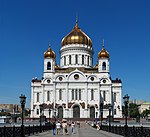
The Moskva Pool (Moscow Pool) was, for a time, the world's largest open air swimming pool.It was built in Moscow in 1958 on the foundation of the abandoned Palace of the Soviets, to the designs of Moscow architect Dmitry Chechulin. Construction of the Palace of Soviets had begun in 1937 and was abandoned in 1941 when steel from the foundation of the building was used for war materials during World War II. The empty foundation of the Palace of the Soviets was, in 1958, made into an open-air swimming pool which existed from 1958 until 1994. The water was heated in order to extend the pool season into colder weather. In 1995 the Cathedral of Christ the Saviour was reconstructed in its place, the original church having been demolished to make way for the Palace of the Soviets.

Excerpt from the Wikipedia article Moskva Pool (License: CC BY-SA 3.0, Authors, Images).

Moskva Pool
Volkhonka Street, Moscow Khamovniki District

Geographical coordinates (GPS) Address Nearby Places
placeShow on map

Wikipedia: Moskva PoolContinue reading on Wikipedia

Geographical coordinates (GPS)

Latitude Longitude
N 55.744444444444 ° E 37.605555555556 °
placeShow on map

Address

Храм Христа Спасителя

Volkhonka Street 15
119019 Moscow, Khamovniki District
Moscow, Russia
mapOpen on Google Maps

Schwimmbad Moskwa
Schwimmbad Moskwa
Share experience

Nearby Places

Palace of the Soviets

The Palace of the Soviets (Russian: Дворец Советов, Dvorets Sovetov) was a project to construct a political convention center in Moscow on the site of the demolished Cathedral of Christ the Saviour. The main function of the palace was to house sessions of the Supreme Soviet in its 130-metre (430 ft) wide and 100-metre (330 ft) tall grand hall seating over 20,000 people. If built, the 416-metre (1,365 ft) tall palace would have become the world's tallest structure, with an internal volume surpassing the combined volumes of the six tallest American skyscrapers.Boris Iofan won a series of four architectural competitions held in 1931–1933 marking the beginning of a sharp turn of Soviet architecture from 1920s modernism to the monumental historicism of Stalinist architecture. The individuals behind these events and their motives remain a matter of conjecture and debate. Recent research supports the hypothesis that Iofan had been the chosen architect from the very start and manipulated the competitions to his own benefit. The definitive design by Iofan, Vladimir Shchuko and Vladimir Helfreich was conceived in 1933–1934 and took its final shape in 1937. The staggered stack of ribbed cylinders crowned with a 100-metre (330 ft) statue of Vladimir Lenin blended Art Deco and neoclassical influences with contemporary American skyscraper technology. Work on the site commenced in 1933; the foundation was completed in January 1939. The German invasion in June 1941 ended the project. Engineers and workers were diverted to defense projects or pressed in the army; the installed structural steel was disassembled in 1942 for fortifications and bridges. After World War II, Joseph Stalin lost interest in the palace. Iofan produced several revised, scaled-down designs but failed to reanimate the project. The alternative Palace of the Soviets in Sparrow Hills, which was proposed after Stalin's death, did not proceed beyond the architectural competition stage.

Kropotkinskaya
Kropotkinskaya

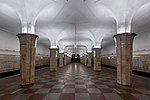
Kropotkinskaya (Russian: Кропо́ткинская, IPA: [krɐˈpotkʲɪnskəjə]) is a station on the Sokolnicheskaya Line of the Moscow Metro. One of the oldest Metro stations, it was designed by Alexey Dushkin and Ya. Likhtenberg and opened in 1935 as part of the original Metro line, named after Russian anarchist Peter Kropotkin. The station was originally planned to serve the enormous Palace of the Soviets (Dvorets Sovetov), which was to rise nearby on the former site of the Cathedral of Christ the Saviour. Kropotkinskaya was therefore designed to be the largest and grandest station on the first line. However, the Palace project was cancelled by Nikita Khrushchev in 1953, leaving the Metro station as the only part of the complex that was actually built. Kropotkinskaya was constructed in a massive open trench measuring 176 metres (577 ft) long by 25 metres (82 ft) wide. The tunnels from Biblioteka Imeni Lenina were constructed using the cut and cover technique. The combination of unrestricted space and dry soil made for ideal conditions, and construction of the station took only 180 days from start to finish. Kropotkinskaya was completed in January 1935 and opened five months later, on 15 May 1935. The station was named Dvorets Sovetov until 1957, when it was renamed in honour of Peter Kropotkin, a geographer, philosopher, and anarchist theoretician born in the vicinity. Since it was to serve as the gateway to the Palace of Soviets, great care was taken to make Kropotkinskaya suitably elegant and impressive. The station has flared columns faced with white marble which are said to have been inspired by the Temple of Amun at Karnak. Contrary to popular opinion, the marble used in the station did not come from the demolished Cathedral. The spacious platform is covered with squares of gray and red granite and the walls, originally tiled, are now faced with white Koyelga marble. The station is illuminated by concealed lamps set into the tops of the columns. A model of the station won two Grand Prix awards at expositions in Paris (1937) and Brussels (1958). In 1941 the designers and engineers were also awarded the Stalin prize of the USSR for architecture and construction. Kropotkinskaya opened with only one entrance vestibule, located at the end of Gogolevskiy Boulevard. This U-shaped structure was designed by S.M. Kravets and features two separate pavilions joined by a central arch. In late 1950s the station was given a slight reconstruction replacing the original cast of the upper pillars was replaced by marble and the floor was relayed with granite. The reconstruction finished with a new entrance which faces the Cathedral and Moskva River which was opened on 16 July 1960. Because of the demise of the Palace of Soviets project, much of Kropotkinskaya's planned ridership never materialized. As of 2013 the station serves about 42,050 passengers daily, many of them tourists visiting the newly rebuilt Cathedral or the Pushkin Museum of Fine Arts. By 2020, a transfer to the Kalininskaya Line is planned to open. The future station will be called Volkhonka.