place

Bolshoy Kamenny Bridge

1692 establishments in RussiaBridges built in the Soviet UnionBridges completed in 1692Bridges completed in 1859Bridges completed in 1938
Bridges in MoscowCultural heritage monuments of regional significance in MoscowDeck arch bridges
Moscow Kremlin and Bolshoy Kamenny Bridge late evening 01

Bolshoy Kamenny Bridge (Russian: Большой Каменный мост, Greater Stone Bridge) is a steel arch bridge spanning Moskva River at the western end of the Moscow Kremlin. Its predecessor was the first permanent stone bridge in Moscow, Russia. The existing bridge was completed in 1938 by engineer Nikolai Kalmykov.

Excerpt from the Wikipedia article Bolshoy Kamenny Bridge (License: CC BY-SA 3.0, Authors, Images).

Bolshoy Kamenny Bridge
Kremlin Embankment, Moscow Tverskoy District

Geographical coordinates (GPS) Address External links Nearby Places
placeShow on map

Wikipedia: Bolshoy Kamenny BridgeContinue reading on Wikipedia

Geographical coordinates (GPS)

Latitude Longitude
N 55.746666666667 ° E 37.612222222222 °
placeShow on map

Address

Большой Каменный мост

Kremlin Embankment
119019 Moscow, Tverskoy District
Moscow, Russia
mapOpen on Google Maps

linkWikiData (Q916741)
linkOpenStreetMap (1794442)

Moscow Kremlin and Bolshoy Kamenny Bridge late evening 01
Share experience

Nearby Places

Armorial Gate
Armorial Gate

The Armorial Gate (Russian: Гербовые ворота, romanized: Gerbovye vorota) was a unique monumental erection of traditional Russian architecture. Situated in the Moscow Kremlin, the structure was symbolic of the centralized Russian state. Its name references polychrome tiles of the second floor, which displayed heraldic (armorial) emblems of formerly independent Russian principalities. When constructing a palace for Ivan III in the late 15th century, the Italian architect Aloisio built an interior brick wall inside the Kremlin to defend the royal palace from south and west. The western wall was pierced by two arches, the smaller for pedestrians and the larger for vehicles. The larger gate was called Kolymazhnye, either from the old Russian word for vehicles or from the Kolymazhny Chamber situated nearby. After the Romanov family ascended the throne in 1613, they rebuilt Ivan's residence into the Terem Palace. At about the same time, in the 1630s, they commissioned a tower to crown the Kolymazhnye Gate leading to the royal court. The tower was square in plan, with the first floor pierced by a wide arch for vehicles. The second floor had twin double-arched windows with decorative elaborations of white stone. The third floor was pierced by a row of machicolations and a row of murder-holes. Above that was a gallery ringed by a perforated parapet. The structure was crowned by a tiled tent, decorated with two levels of dormers and surmounted by a heraldic double-headed eagle. By the 19th century, the wall had lost its defensive purpose and was dismantled. After that, the detached tower appeared redundant and was pulled down at the urging of the Kremlin's castellan in 1807.

Biblioteka Imeni Lenina

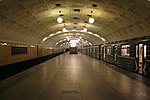
Biblioteka Imeni Lenina (Russian: Библиоте́ка и́мени Ле́нина, English: Lenin Library) is a station on the Sokolnicheskaya Line of the Moscow Metro. The station was opened on 15 May 1935 as a part of the first stage of the Metro. It is situated in the very centre of the city under Mokhovaya Street, and is named for the nearby Russian State Library (named the Lenin Library from 1925 until 1992). Its architects were A. I. Gontskevich and S. Sulin. To prevent the disruption of traffic, Biblioteka Imeni Lenina was built using underground excavation rather than cut and cover even though the station ceiling is just two metres (6.5 ft) below ground level. Soil conditions and the narrowness of the space in which the station was to be built necessitated a single-vault design, the only one on the first Metro line. The entire excavation was only 19.8 metres (65 ft) wide and 11.7 metres (38 ft) high. The main station vault was built from rubble stone set in concrete and reinforced with an iron framework. This was lined with an "umbrella" of bitumen-coated paper to prevent groundwater from seeping into the station. The station was finished with plaster, yellow ceramic tile, and marble. The station originally had two entrance vestibules, one at either end. The southern vestibule, located between the old and new buildings of the State Library, is shared with Borovitskaya. The temporary northern vestibule, which served Biblioteka Imeni Lenina and Aleksandrovsky Sad, was removed in the 1940s.