place

Xujiahui station

Line 1, Shanghai MetroLine 11, Shanghai MetroLine 9, Shanghai MetroRailway stations in China opened in 1993Shanghai Metro stations in Xuhui District
Shanghai Metro stubs
201609 Platform for L1 of Xujiahui Station

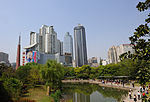
Xujiahui (simplified Chinese: 徐家汇; traditional Chinese: 徐家匯; pinyin: Xújiāhuì) is an interchange station between lines 1, 9 and 11 of the Shanghai Metro. It is located in the Xujiahui area of Xuhui District, Shanghai. The station is one of the busiest in the metro system, and is extremely crowded during peak hours. Six large shopping malls and eight large office towers are each within no more than a three-minute walk of one of the station's exits. The station has a total of 20 exits, more than any other subway station in Shanghai. This station is part of the initial southern section of the line that opened on 28 May 1993; the interchanges with Line 9 and Line 11 opened respectively on 31 December 2009 and 31 August 2013.

Excerpt from the Wikipedia article Xujiahui station (License: CC BY-SA 3.0, Authors, Images).

Xujiahui station
Xingeng Road, Xuhui District

Geographical coordinates (GPS) Address Nearby Places
placeShow on map

Wikipedia: Xujiahui stationContinue reading on Wikipedia

Geographical coordinates (GPS)

Latitude Longitude
N 31.19454 ° E 121.4379 °
placeShow on map

Address

辛耕路天钥桥路(徐家汇)

Xingeng Road
200243 Xuhui District
China
mapOpen on Google Maps

201609 Platform for L1 of Xujiahui Station
Share experience

Nearby Places

Tomb of Xu Guangqi
Tomb of Xu Guangqi

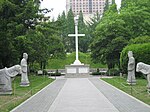
The tomb of Xu Guangqi is the burial site of Xu Guangqi (24 April 1562 – 10 November 1633), a prominent late Ming dynasty statesman, scholar, and leader of the Catholic community, as well as some of his relatives. It is located north of Xujiahui, Shanghai, in the present-day Guangqi Park, covering an area of 3,000 square meters and standing 2.2 meters tall. The tomb is elliptical in shape. In the seventh year of the Chongzhen era (1634), he was posthumously granted the privilege of burial with the rank of a first-rank official, and a special envoy was dispatched to escort his coffin back to Shanghai for burial. Due to the unsettled situation at the time, the coffin was temporarily placed outside the Da'nan Gate of Shanghai (Old City) in the Shuangyuan Villa. In the fourteenth year of the Chongzhen era (1641), he was finally buried in the southwest corner of Gaochang Township, Shanghai County, Songjiang Prefecture. In the twenty-ninth year of the Guangxu era (1903), the Catholic Vicariate of Kiang-nan renovated and expanded the tomb. It was once abandoned, even turned into a vegetable garden. In 1957, it was briefly rebuilt.: 210  During the Cultural Revolution, it became an open-air warehouse and was severely damaged. It was once again restored in 1983. In 2003, it was reconstructed according to the tomb's design from 1903 and has since been well-maintained. On 26 May 1959, and 7 December 1977, the tomb of Xu Guangqi was declared a cultural relic protection unit of Shanghai. On 13 January 1988, it was announced as a national major cultural relic protection unit by the State Council.