place

Xujiahui Tower

2024 in ShanghaiPeople's Republic of China building and structure stubsProposed buildings and structures in ShanghaiProposed skyscrapers in ChinaSkyscrapers in Shanghai
Xujiahui 1
Xujiahui 1

The Xujiahui Center is a complex of skyscrapers under construction in Shanghai, China. Upon its completion in 2024, the main tower will be the fourth tallest building in Shanghai, after the Shanghai Tower, Shanghai World Financial Center, and the Jin Mao Tower.

Excerpt from the Wikipedia article Xujiahui Tower (License: CC BY-SA 3.0, Authors, Images).

Xujiahui Tower
Hongqiao Road, Xuhui District Xujiahui

Geographical coordinates (GPS) Address Nearby Places
placeShow on map

Wikipedia: Xujiahui TowerContinue reading on Wikipedia

Geographical coordinates (GPS)

Latitude Longitude
N 31.196 ° E 121.43 °
placeShow on map

Address

虹桥路

Hongqiao Road
200030 Xuhui District, Xujiahui
Shanghai, China
mapOpen on Google Maps

Xujiahui 1
Xujiahui 1
Share experience

Nearby Places

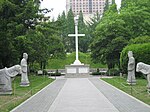
Tomb of Xu Guangqi
Tomb of Xu Guangqi

The tomb of Xu Guangqi is the burial site of Xu Guangqi (24 April 1562 – 10 November 1633), a prominent late Ming dynasty statesman, scholar, and leader of the Catholic community, as well as some of his relatives. It is located north of Xujiahui, Shanghai, in the present-day Guangqi Park, covering an area of 3,000 square meters and standing 2.2 meters tall. The tomb is elliptical in shape. In the seventh year of the Chongzhen era (1634), he was posthumously granted the privilege of burial with the rank of a first-rank official, and a special envoy was dispatched to escort his coffin back to Shanghai for burial. Due to the unsettled situation at the time, the coffin was temporarily placed outside the Da'nan Gate of Shanghai (Old City) in the Shuangyuan Villa. In the fourteenth year of the Chongzhen era (1641), he was finally buried in the southwest corner of Gaochang Township, Shanghai County, Songjiang Prefecture. In the twenty-ninth year of the Guangxu era (1903), the Catholic Vicariate of Kiang-nan renovated and expanded the tomb. It was once abandoned, even turned into a vegetable garden. In 1957, it was briefly rebuilt.: 210  During the Cultural Revolution, it became an open-air warehouse and was severely damaged. It was once again restored in 1983. In 2003, it was reconstructed according to the tomb's design from 1903 and has since been well-maintained. On 26 May 1959, and 7 December 1977, the tomb of Xu Guangqi was declared a cultural relic protection unit of Shanghai. On 13 January 1988, it was announced as a national major cultural relic protection unit by the State Council.

Shanghai Jiao Tong University

Shanghai Jiao Tong University (SJTU; simplified Chinese: 上海交通大学; traditional Chinese: 上海交通大學) is a major public research university in Shanghai, China. Established on April 8, 1896, as Nanyang Public School (南洋公學) by an imperial edict issued by the Guangxu Emperor, it is one of China's oldest and most prestigious universities. Directly governed by the Ministry of Education of China, SJTU is a member of the C9 League and Class A Double First Class Universities, standing for top national universities of China. It is also designated a leading institution in the Double First Class University Plan, Project 985, and Project 211.Back in the 1930s when SJTU had not yet been separated from National Chiao Tung University, its predecessor had already achieved world renown and been referred to as the "Eastern MIT". The university underwent a number of reformations and gained its current name in 1959. Shanghai Second Medical University was merged into the university on July 18, 2005, and developed into a medical school in China under the name Shanghai Jiao Tong University School of Medicine.Shanghai Jiao Tong University consistently features in the world's top 100 universities as ranked by the Academic Ranking of World Universities, the QS World University Rankings, and the Times Higher Education World University Rankings. It is ranked No. 3 nationwide by the U.S. News, and No. 50 in the world according to the QS World University Rankings, with several subjects like Marine Engineering, Biomedical Engineering, Mechanical Engineering, Metallurgical Engineering, Telecommunication Engineering and Transportation Engineering ranked top 10 globally by ARWU.