place

Metro-City

Shopping malls in ShanghaiXuhui District
Metro City shanghai
Metro City shanghai

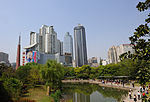
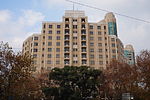
Metro-City (Chinese: 美罗城; pinyin: Měiluō Chéng) is a shopping mall in the Xujiahui area of Shanghai, China. It was built in 1989 and serves as one of the landmarks of the area, much because of the surrounding gigantic hemispherical structure that glows by evening. It is known for being the main electronics market in Shanghai, since most of its floors are occupied by sellers of computers, cameras, mobile phones, video-game consoles, etc. It also home to many restaurants and cafés while there is a cinema on the top floor.

Excerpt from the Wikipedia article Metro-City (License: CC BY-SA 3.0, Authors, Images).

Metro-City
Tianyaoqiao Road, Xuhui District

Geographical coordinates (GPS) Address Nearby Places
placeShow on map

Wikipedia: Metro-CityContinue reading on Wikipedia

Geographical coordinates (GPS)

Latitude Longitude
N 31.193 ° E 121.439 °
placeShow on map

Address

上海市宛平中学

Tianyaoqiao Road
200030 Xuhui District
China
mapOpen on Google Maps

Metro City shanghai
Metro City shanghai
Share experience

Nearby Places

Tomb of Xu Guangqi
Tomb of Xu Guangqi

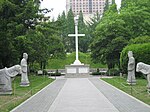
The tomb of Xu Guangqi is the burial site of Xu Guangqi (24 April 1562 – 10 November 1633), a prominent late Ming dynasty statesman, scholar, and leader of the Catholic community, as well as some of his relatives. It is located north of Xujiahui, Shanghai, in the present-day Guangqi Park, covering an area of 3,000 square meters and standing 2.2 meters tall. The tomb is elliptical in shape. In the seventh year of the Chongzhen era (1634), he was posthumously granted the privilege of burial with the rank of a first-rank official, and a special envoy was dispatched to escort his coffin back to Shanghai for burial. Due to the unsettled situation at the time, the coffin was temporarily placed outside the Da'nan Gate of Shanghai (Old City) in the Shuangyuan Villa. In the fourteenth year of the Chongzhen era (1641), he was finally buried in the southwest corner of Gaochang Township, Shanghai County, Songjiang Prefecture. In the twenty-ninth year of the Guangxu era (1903), the Catholic Vicariate of Kiang-nan renovated and expanded the tomb. It was once abandoned, even turned into a vegetable garden. In 1957, it was briefly rebuilt.: 210  During the Cultural Revolution, it became an open-air warehouse and was severely damaged. It was once again restored in 1983. In 2003, it was reconstructed according to the tomb's design from 1903 and has since been well-maintained. On 26 May 1959, and 7 December 1977, the tomb of Xu Guangqi was declared a cultural relic protection unit of Shanghai. On 13 January 1988, it was announced as a national major cultural relic protection unit by the State Council.