place

Castle Geyser

Geothermal features of Teton County, WyomingGeothermal features of Yellowstone National ParkGeysers of Teton County, WyomingGeysers of Wyoming
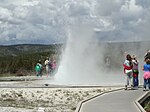
Steam Phase eruption of Castle geyser with double rainbow

Castle Geyser is a cone geyser in the Upper Geyser Basin of Yellowstone National Park. It is noted for the particularly large geyserite sinter deposits, which form its cone. These deposits have been likened in appearance to a castle.When the geyser was given this name in 1870, the top edges of the structure resembled the typical profile associated with the modern concept of a castle, having the appearance of a large keep, multiple turrets, and especially because of the crenellation along the top edges of what resembled its towers. As the drawing below shows the cone had distinctive appearance at the time. Over time the cone's shape changes because of the layers of mineral deposited in successive eruptions.

Excerpt from the Wikipedia article Castle Geyser (License: CC BY-SA 3.0, Authors, Images).

Castle Geyser
Continental Divide National Scenic trail,

Geographical coordinates (GPS) Address External links Nearby Places
placeShow on map

Wikipedia: Castle GeyserContinue reading on Wikipedia

Geographical coordinates (GPS)

Latitude Longitude
N 44.463445 ° E -110.83666 °
placeShow on map

Address

Castle Geyser

Continental Divide National Scenic trail

Wyoming, United States
mapOpen on Google Maps

linkWikiData (Q1049360)
linkOpenStreetMap (356505742)

Steam Phase eruption of Castle geyser with double rainbow
Share experience

Nearby Places

Sawmill Geyser
Sawmill Geyser

Sawmill Geyser, named for the whirring sound it makes during its eruption, is a geyser in Yellowstone National Park, Wyoming, United States. The geyser was named by Antoine Schoenborn of the Hayden Geological Survey of 1871. Sawmill is the largest geyser in the Sawmill Complex, a region of geothermal features located in Upper Geyser Basin approximately 10 feet off the path. The geyser has an irregular pattern of eruption due to the underground structural interconnectivity which is characteristic of geyser complexes. Despite this, it tends to have a delay around 1 to 3 hours between eruptions. Often, Sawmill will erupt after the nearby Spasmodic Geyser, but only if Penta Geyser, another significant geyser in the complex, does not erupt first. If Penta erupts before Sawmill, Sawmill is cut off from water, and cannot erupt until the basin is reloaded, indicated by an eruption by Spasmodic. Another eruption indicator is when Sawmill fills with the rest of the geyser's water in the Sawmill Complex or starts to overflow, bubbles tend to rise to the surface. This indicates that an eruption is near. Sawmill drains after its eruptions, and if it had a large eruption prior, unusual behavior can occur in other geysers in the area. Sawmill was a frequent eruptor in recent years prior to January or February 2017, when it suddenly ceased eruptive activity for over four years. According to reports submitted to GeyserTimes.org, Sawmill's last observed eruption for over four years occurred during the morning hours of January 29, 2017. Sawmill Geyser resumed eruptive activity with an eruption at 2:00 AM on June 24, 2021.