place

Skhodnya (river)

Moscow geography stubsPages with Russian IPARivers of MoscowRivers of Moscow OblastRussia river stubs
Tributaries of the Moskva
Zelenograd Large City Pond

The Skhodnya (Russian: Сходня, IPA: [ˈsxodʲnʲə]) is a river in the northwest of Moscow and Moscow Oblast, Russia. It is the second-largest tributary of the Moskva, after the Yauza. It is 47 kilometres (29 mi) long (of which 5 km in Moscow proper), and has a drainage basin of 255 square kilometres (98 sq mi). The Skhodnya originates near the village of Alabushevo (part of Zelenograd) and flows into the Moskva River near the Tushino Airfield. The Skhodnya is connected with a derivational canal, which supplies water from the Volga through the Khimki Reservoir (with the help of the Skhodnenskaya hydroelectric plant) to Moscow for sanitary irrigation.

Excerpt from the Wikipedia article Skhodnya (river) (License: CC BY-SA 3.0, Authors, Images).

Skhodnya (river)
Покровская набережная, Moscow Pokrovskoye-Streshnevo District

Geographical coordinates (GPS) Address Nearby Places
placeShow on map

Wikipedia: Skhodnya (river)Continue reading on Wikipedia

Geographical coordinates (GPS)

Latitude Longitude
N 55.8234 ° E 37.4122 °
placeShow on map

Address

Водно-спортивная база «Буревестник»

Покровская набережная
125371 Moscow, Pokrovskoye-Streshnevo District
Moscow, Russia
mapOpen on Google Maps

Zelenograd Large City Pond
Share experience

Nearby Places

Strogino (Arbatsko-Pokrovskaya line)

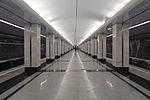
Strogino (Russian: Строгино́) is a Moscow Metro station in the Strogino District, North-Western Administrative Okrug, Moscow. It is on the Arbatsko-Pokrovskaya Line, between Myakinino and Krylatskoye stations. The station opened on 7 January 2008 as a part of a massive Strogino–Mitino extension, and used to be the terminus of the line until its extension to Mitino on 26 December 2009. Originally planned as part of a massive chordal line, construction began in the late 1980s, but after major delays in finances work has stalled and was restarted much later, in 2004. The overall design, adopted by architects A. Orlov and A. Nekrasov is a shallow depth single vault. Running along its snow-white colour, is a set of wedges which contain 16 triangle-shaped caissons, each housing the lighting element, in shape of a giant droplet. The platform itself is covered in bright grey granite and contains a series of arrow-shaped benches made of wood with stainless steel markings. The station contains two vestibules, both located under the Stroginsky Boulevard, although the opening of the Western one was postponed due to the delays of escalator contractor in Saint Petersburg. Both vestibules are connected to subways that lead to large glazed pavilions, located not far from the intersection with the Tallinskaya street (Eastern) and the Kulakova street (Western). As the station was only the first stage of the extension, its terminus state was temporary, as the line continues northwestward to Mitino since December 2009. There were plans to make this station a cross-platform interchange with the Kalininskaya Line which would then take over the Mitino extension, and the terminus station of the Arbatsko-Pokrovskaya would revert to Strogino; however, currently Kalininskaya Line is projected to be connected to the Solntsevsky radius.

Crocus City Hall attack

On 22 March 2024, a terrorist attack carried out by the Islamic State occurred at the Crocus City Hall music venue in Krasnogorsk, Moscow Oblast, Russia. The attack began at around 20:00 MSK (UTC+3), shortly before the Russian band Picnic was scheduled to play a sold-out show at the venue. Four gunmen carried out a mass shooting, as well as slashing attacks on the people gathered at the venue, and used incendiary devices to set the venue on fire. Investigators said the attack had killed 145 people (including those who died later in hospital), and more than 551 concertgoers were injured by gunshot wounds and fire-related injuries. On 28 March, Russian authorities also claimed that a further 95 people were missing.The Islamic State claimed responsibility for the attack in a statement through the IS-affiliated Amaq News Agency shortly after the attack, with its regional branch in the Afghanistan–Pakistan border region, Islamic State – Khorasan Province (IS–KP or ISIS-K), most likely being responsible. Amaq also published a video filmed by one of the attackers. It showed the attackers shooting victims and slitting the throat of a victim, while the filming attacker was reciting the takbir, praising God and speaking against infidels.Russian president Vladimir Putin called the attack a "barbaric terrorist act" and said that the gunmen had been arrested. He also declared 24 March 2024 to be a national day of mourning, and sought to link assailants to Ukraine. Russia's Foreign Ministry called the incident a terrorist attack. It was the deadliest terrorist attack on Russian soil since the Beslan school siege in 2004. Investigators detained 11 people in relation to the attack, including four suspects, who were charged with terrorism later on 24 March.