place

Wadena, Indiana

Lafayette metropolitan area, IndianaUnincorporated communities in Benton County, IndianaUnincorporated communities in IndianaUse mdy dates from July 2023
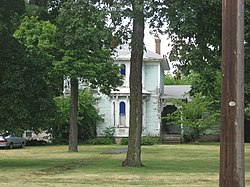
Wadena, Indiana street

Wadena is an unincorporated community in Union Township, Benton County, in the U.S. state of Indiana. It is part of the Lafayette, Indiana Metropolitan Statistical Area.

Excerpt from the Wikipedia article Wadena, Indiana (License: CC BY-SA 3.0, Authors, Images).

Wadena, Indiana
East 600 North,

Geographical coordinates (GPS) Address Nearby Places
placeShow on map

Wikipedia: Wadena, IndianaContinue reading on Wikipedia

Geographical coordinates (GPS)

Latitude Longitude
N 40.693333333333 ° E -87.276666666667 °
placeShow on map

Address

East 600 North 2491
47944
Indiana, United States
mapOpen on Google Maps

Wadena, Indiana street
Share experience

Nearby Places

Kentland crater
Kentland crater

The Kentland structure, also known as the Kentland crater or the Kentland disturbed area, is an impact structure located near the town of Kentland in Newton County, Indiana, United States.It was discovered about 1880 when two farmers began to quarry crushed rock there. The presence of shatter cones and deformed bedrock led geologists to conclude by the late 1960s that the Kentland structure is a deeply eroded impact structure, rather than volcanic in origin. Deformation at the site is so great that vertical contacts between normally horizontal rock formations of different ages are common. The structure itself is a circular dome, about 7.24 km (4.50 mi) in diameter, deeply eroded and buried in glacial debris. Its age is estimated to be less than 97 million years (Cretaceous or younger). The Shakopee dolomite at the center of the structure is about 450 million years old (Ordovician period) and is uplifted about 2,000 feet higher than the level of the same rock in the surrounding area. The entire disturbed area is about 13 km (8.1 mi) in diameter. The estimated age is in dispute. ‘"97 MYA‘" Late Cretaceous Period of the Mesozoic Era ‘"300 MYA‘= Bzhelian or Late Pennsylvanian Epoch (Carboniferous Period) of the Paleozoic EraThis impact structure was studied in 1978. John Weber and his associates presented fission track dating of apatite from this impact structure. Coesite and shatter cones are found in the uplift near its center. The impact structure is exposed to the surface, resulting in erosion. It is currently being worked as a quarry.

Remington Water Tower and Town Hall

The Water Tower was built in 1897 by Challenge Wind and Feed mill Company of Batavia, Illinois. This is a rare wooden tank atop a brick tower type of water tower. Built on a limestone foundation, it is 140 feet (43 m) tall and about 20 feet (6.1 m) in diameter. The brick walls are 2 feet (0.61 m) thick. The original tank was replaced by the Challenge Company in 1924. The tank is made of horizontal battens of cypress, held in place by metal binder rings. The Water Tower and Town Hall, constructed in 1897. Remington, the largest community in Carpenter Township. The town has of approximately 1250 people, founded in 1860. The area is predominantly agricultural. The early stimulus for the growth was the Toledo, Logansport & Burlington Railroad line, established in 1859. The water tower was in use until 1984 when a new water tower was built. The Challenge Wind Mill & Feed Mill Company of Batavia, Illinois constructed the water tower and town hall. Built with a limestone foundation, common bond brick tower and cypress wood tank measure 104 feet (32 m) high and 20 feet (6.1 m) in diameter. The brick walls are 2 feet (0.61 m) thick. The water tank holds 66,000 US gallons (250,000 L). The double semicircular header bond arched opening holds two ledged batten doors that open out. A dedication plaque from the Challenge Wind Mill and Feed Mill Company is affixed above the door. Spiraling up the water tower are a series of eight arched wood frame windows with limestone sills. There are two windows on each "side" facing the cardinal points.The water tank is constructed of horizontally curved cypress battens and dates to 1927. The roof of the water tank was originally cedar shingles but it was replaced in 2003 with plywood and rolled shingles. The 18 by 12 feet (5.5 by 3.7 m) single story brick structure on the east side may have housed the town hall. It sits on a limestone foundation and is constructed of painted common bond brick. The low pitched gable roof is covered with asphalt shingles and conforms on the west end to the curve of the water tower.