place

Palace of Axayacatl

Archaeological sites in MexicoBuildings and structures in MesoamericaTenochtitlan
Placa Palacio de Axayácatl

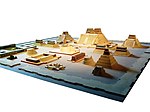
The Palace of Axayacatl, also known as the Old House of Moctezuma, (Spanish: Palacio de Axayácatl) is the name of a pre-Hispanic residential complex composed of interconnected palaces. The complex served as the royal palace and chambers of Tenochtitlan's sixth emperor Axayacatl, and later as the residence of Hernán Cortés. Only ruins of the Palace exist today.

Excerpt from the Wikipedia article Palace of Axayacatl (License: CC BY-SA 3.0, Authors, Images).

Palace of Axayacatl
Avenida 5 de Mayo, Mexico City

Geographical coordinates (GPS) Address Nearby Places
placeShow on map

Wikipedia: Palace of AxayacatlContinue reading on Wikipedia

Geographical coordinates (GPS)

Latitude Longitude
N 19.43435 ° E -99.134083333333 °
placeShow on map

Address

Nacional Monte de Piedad

Avenida 5 de Mayo
06000 Mexico City
Mexico City, Mexico
mapOpen on Google Maps

Placa Palacio de Axayácatl
Share experience

Nearby Places

Mexico City Metropolitan Cathedral

The Metropolitan Cathedral of the Assumption of the Most Blessed Virgin Mary into Heaven (Spanish: Catedral Metropolitana de la Asunción de la Santísima Virgen María a los cielos) is the cathedral church of the Roman Catholic Archdiocese of Mexico. It is situated atop the former Aztec sacred precinct near the Templo Mayor on the northern side of the Plaza de la Constitución (Zócalo) in the historic center of Mexico City. The cathedral was built in sections from 1573 to 1813 around the original church that was constructed soon after the Spanish conquest of Tenochtitlan, eventually replacing it entirely. Spanish architect Claudio de Arciniega planned the construction, drawing inspiration from Gothic cathedrals in Spain.Due to the long time it took to build it, just under 250 years, virtually all the main architects, painters, sculptors, gilding masters and other plastic artists of the viceroyalty worked at some point in the construction of the enclosure. The long construction time also led to the integration of a number of architectural styles in its design, including the Gothic, Baroque, Churrigueresque, Neoclassical styles, as they came into vogue over the centuries. It furthermore allowed the cathedral to include different ornaments, paintings, sculptures and furniture in its interior. The project was a point of social cohesion, because it involved so many generations and social classes, including ecclesiastical authorities, government authorities, and different religious orders.The influence of the Catholic Church on public life has meant that the building was often the scene of historically significant events in New Spain and independent Mexico. These include the coronation of Agustín de Iturbide and Ana María Huarte as emperors of Mexico by the President of the Congress; the preservation of the funeral remains of the aforementioned emperor; burial, until 1925, of several of the independence heroes, such as Miguel Hidalgo y Costilla and José María Morelos; the disputes between liberals and conservatives caused by the separation of the church and the state in the Reform; the closure of the building in the days of the Cristero War; and the celebrations of the bicentennial of independence, among others.The cathedral faces south. It is approximately 59 metres (194 ft) wide by 128 metres (420 ft) long, with a height of 67 metres (220 ft) to the tip of the towers. It consists of two bell towers, a central dome, and three main portals. It has four façades which contain portals flanked with columns and statues. It has five naves consisting of 51 vaults, 74 arches and 40 columns. The two bell towers contain 25 bells. The tabernacle, adjacent to the cathedral, contains the baptistery and serves to register the parishioners. There are five large, ornate altars, a sacristy, a choir, a choir area, a corridor and a capitulary room. Fourteen of the cathedral's sixteen chapels are open to the public. Each chapel is dedicated to a different saint or saints, and each was sponsored by a religious guild. The chapels contain ornate altars, altarpieces, retablos, paintings, furniture and sculptures. The cathedral is home to two of the largest 18th-century organs in the Americas. There is a crypt underneath the cathedral that holds the remains of many former archbishops. The cathedral has approximately 150 windows.Over the centuries, the cathedral has suffered damage. A fire in 1967 destroyed a significant part of the cathedral's interior. The restoration work that followed uncovered a number of important documents and artwork that had previously been hidden. Although a solid foundation was built for the cathedral, the soft clay soil it is built on has been a threat to its structural integrity. Dropping water tables and accelerated sinking caused the structure to be added to the World Monuments Fund list of the 100 Most Endangered Sites. Restoration working beginning in the 1990s stabilized the cathedral and it was removed from the endangered list in 2000.

Mexico City
Mexico City

Mexico City (Spanish: Ciudad de México, locally [sjuˈða(ð) ðe ˈmexiko] (listen); abbr.: CDMX; Nahuatl: Altepetl Mexico) is the capital, largest city of Mexico, and the most populous city in North America. It is one of the country's 32 federal entities. Mexico City is one of the most important cultural and financial centers in the world. It is located in the Valley of Mexico in the high central plateau, at an altitude of 2,240 meters (7,350 ft). The city has 16 boroughs or demarcaciones territoriales, which are in turn divided into neighborhoods or colonias. The 2020 population for the city proper was 9,209,944, with a land area of 1,495 square kilometers (577 sq mi). According to the most recent definition agreed upon by the federal and state governments, the population of Greater Mexico City is 21,804,515, which makes it the sixth-largest metropolitan area in the world, the second-largest urban agglomeration in the Western Hemisphere (behind São Paulo, Brazil), and the largest Spanish-speaking city (city proper) in the world. Greater Mexico City has a GDP of $411 billion in 2011, which makes it one of the most productive urban areas in the world. The city was responsible for generating 15.8% of Mexico's GDP, and the metropolitan area accounted for about 22% of the country's GDP. If it were an independent country in 2013, Mexico City would be the fifth-largest economy in Latin America.Mexico's capital is both the oldest capital city in the Americas and one of two founded by indigenous people. The city was originally built on a group of islands in Lake Texcoco by the Mexica (Azteca) in 1325 as Tenochtitlan. It was almost completely destroyed in the 1521 Siege of Tenochtitlan and subsequently redesigned and rebuilt in accordance with the Spanish urban standards. In 1524, the municipality of Mexico City was established, known as México Tenochtitlán, and as of 1585, it was officially known as Ciudad de México (Mexico City). Mexico City was the political, administrative, and financial center of a major part of the Spanish colonial empire. After independence from Spain was achieved, the federal district was created in 1824. After years of demanding greater political autonomy, residents were finally given the right to elect both a head of government and the representatives of the unicameral Legislative Assembly by election in 1997. Ever since, left-wing parties (first the Party of the Democratic Revolution and later the National Regeneration Movement) have controlled both of them. The city has several progressive policies, such as abortion on demand, a limited form of euthanasia, no-fault divorce, and same-sex marriage. On 29 January 2016, it ceased to be the Federal District (Spanish: Distrito Federal or D.F.) and is now officially known as Ciudad de México (or CDMX), with a greater degree of autonomy. A clause in the Constitution of Mexico, however, prevents it from becoming a state within the Mexican federation, as it is the seat of power in the country, unless the capital of the country were to be relocated elsewhere.

First Mexican Republic

The First Mexican Republic, known also as the First Federal Republic (Spanish: Primera República Federal), was a federated republic, under the Constitution of 1824. It was a nation-state officially designated the United Mexican States (Spanish: Estados Unidos Mexicanos, listen ). The First Mexican Republic lasted from 1824 to 1835, when conservatives under Antonio López de Santa Anna transformed it into a unitary state, the Centralist Republic of Mexico. The republic was proclaimed on November 1, 1823 by the Constituent Congress, months after the fall of the Mexican Empire ruled emperor Agustin I, a former royalist military officer-turned-insurgent for independence. The federation was formally and legally established on October 4, 1824, when the Federal Constitution of the United Mexican States came into force.The First Republic was plagued through its entire twelve-year existence by severe financial and political instability. Political controversies, ever since the drafting of the constitution tended to center around whether Mexico should be a federal or a centralist state, with wider liberal and conservative causes attaching themselves to each faction respectively. With the exception of the inaugural office holder, Guadalupe Victoria, every single administration during the First Republic was overthrown by military coup d'état. The First Republic would finlly collapse after the overthrow of the liberal president Valentín Gómez Farías, through a rebellion led by his former vice-president, General Antonio López de Santa Anna who had switched sides. Once in power, the conservatives, who had long been critical of the federal system and blamed it for the nation's instability, repealed the Constitution of 1824 on October 23, 1835, and the Federal Republic became a unitary state, the Centralist Republic. The unitary regime was formally established on December 30, 1836, with the enactment of the seven constitutional laws.

Second Federal Republic of Mexico

The Second Federal Republic of Mexico (Spanish: Segunda República Federal de México) is the name given to the second attempt to achieve a federalist government in Mexico after a period of centralism. Officially called the United Mexican States (Estados Unidos Mexicanos), a federal republic was established again on August 22, 1846 when interim president José Mariano Salas issued a decree restoring the 1824 constitution. The Second Republic continued to be rocked by the political instability that had characterized Mexico since independence. Mexico's loss in the war with the United States during this time saw half of Mexican territory become part of the United States. Antonio López de Santa Anna who had played a major role in the war, and been disgraced as a result, afterwards returned to the presidency, selling more territory to the United States and becoming increasingly autocratic. In response, liberals promulgated of the Plan of Ayutla in 1854, calling for the overthrow of Santa Anna's dictatorship. Santa Anna was overthrown and liberals enacted a series of sweeping reforms, including a new federalist constitution, collectively known as the Liberal Reform, which then sparked a civil war with conservatives, known as the War of the Reform, from 1857 to 1860. The conservatives lost the war, but the liberals' triumph however was soon interrupted by a French invasion in 1861, which gained collaboration from the recently defeated conservatives. The French attempted to set up a client state known as the Second Mexican Empire. Conservatives invited Maximilian Habsburg to serve as monarch of the Empire. Mexican republicans nonetheless fought against the French invaders, led by Benito Juárez's government in exile, which was backed by the United States. Ultimately the French were unable to consolidate control of the entire nation and under pressure from the United States which after the end of the Civil War, could more effectively enforce the Monroe Doctrine, withdrew from Mexico, leading to the Empire's collapse in 1867. The period of the Second Republic following the end of the Second Empire, is known as the Restored Republic.