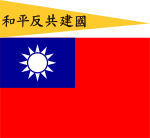
The Wang Jingwei regime, officially the Reorganized National Government of the Republic of China (Chinese: 中華民國國民政府; pinyin: Zhōnghuá Mínguó Guómín Zhèngfǔ) was a puppet state of the Empire of Japan in eastern China. It existed alongside the Nationalist government of the Republic of China under Chiang Kai-shek, which was fighting Japan along with the other Allies of World War II. The country functioned as a dictatorship under Wang Jingwei, formerly a high-ranking official of the Nationalist Kuomintang (KMT). The region it administered was initially seized by Japan during the late 1930s at the beginning of the Second Sino-Japanese War.
Wang, a rival of Chiang Kai-shek and member of the pro-peace faction of the KMT, defected to the Japanese side and formed a collaborationist government in occupied Nanjing in 1940, as well as a concurrent collaborationist Kuomintang that ruled the new government. The new state claimed the entirety of China (outside the Japanese puppet state of Manchukuo) during its existence, portraying itself as the legitimate inheritors of the Xinhai Revolution and Sun Yat-sen's legacy as opposed to Chiang's government in Chongqing, but effectively only Japanese-occupied territory was under its direct control. Its international recognition was limited to other members of the Anti-Comintern Pact, of which it was a signatory. The Reorganized National Government existed until the end of World War II and the surrender of Japan in August 1945, at which point the regime was dissolved and many of its leading members were executed for treason.
The state was formed by combining the previous Reformed Government (1938–1940) and Provisional Government (1937–1940) of the Republic of China, puppet regimes which ruled the central and northern regions of China that were under Japanese control, respectively. Unlike Wang Jingwei's government, these regimes were not much more than arms of the Japanese military leadership and received no recognition even from Japan itself or its allies. However, after 1940 the former territory of the Provisional Government remained semi-autonomous from Nanjing's control, under the name "North China Political Council". The region of Mengjiang (puppet government in Inner Mongolia) was under Wang Jingwei's government only nominally. His regime was also hampered by the fact that the powers granted to it by the Japanese were extremely limited, and this was only partly changed with the signing of a new treaty in 1943 which gave it more sovereignty from Japanese control. The Japanese largely viewed it as not an end in itself but the means to an end, a bridge for negotiations with Chiang Kai-shek, which led them to often treat Wang with indifference.
 Continue reading on Wikipedia