place

Qingliangshan Park

Buildings and structures in NanjingParks in Nanjing
Qingliangshan Park Gate

Qingliangshan Park (Chinese: (清凉山公园; lit. 'cooling hill'), is a 73 hectares (180 acres) park located in the Gulou District, Nanjing, China. It sits on Qingliang Hill, which is more than 100 metres (330 ft) high and 4 kilometres (2.5 mi) in radius.

Excerpt from the Wikipedia article Qingliangshan Park (License: CC BY-SA 3.0, Authors, Images).

Qingliangshan Park
广州路, Gulou District 华侨路街道

Geographical coordinates (GPS) Address Nearby Places
placeShow on map

Wikipedia: Qingliangshan ParkContinue reading on Wikipedia

Geographical coordinates (GPS)

Latitude Longitude
N 32.051944444444 ° E 118.75666666667 °
placeShow on map

Address

清凉山

广州路
210093 Gulou District, 华侨路街道
Jiangsu, China
mapOpen on Google Maps

Qingliangshan Park Gate
Share experience

Nearby Places

Wang Jingwei regime
Wang Jingwei regime

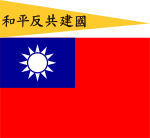
The Wang Jingwei regime, officially the Reorganized National Government of the Republic of China (Chinese: 中華民國國民政府; pinyin: Zhōnghuá Mínguó Guómín Zhèngfǔ) was a puppet state of the Empire of Japan in eastern China. It existed alongside the Nationalist government of the Republic of China under Chiang Kai-shek, which was fighting Japan along with the other Allies of World War II. The country functioned as a dictatorship under Wang Jingwei, formerly a high-ranking official of the Nationalist Kuomintang (KMT). The region it administered was initially seized by Japan during the late 1930s at the beginning of the Second Sino-Japanese War. Wang, a rival of Chiang Kai-shek and member of the pro-peace faction of the KMT, defected to the Japanese side and formed a collaborationist government in occupied Nanjing in 1940, as well as a concurrent collaborationist Kuomintang that ruled the new government. The new state claimed the entirety of China (outside the Japanese puppet state of Manchukuo) during its existence, portraying itself as the legitimate inheritors of the Xinhai Revolution and Sun Yat-sen's legacy as opposed to Chiang's government in Chongqing, but effectively only Japanese-occupied territory was under its direct control. Its international recognition was limited to other members of the Anti-Comintern Pact, of which it was a signatory. The Reorganized National Government existed until the end of World War II and the surrender of Japan in August 1945, at which point the regime was dissolved and many of its leading members were executed for treason. The state was formed by combining the previous Reformed Government (1938–1940) and Provisional Government (1937–1940) of the Republic of China, puppet regimes which ruled the central and northern regions of China that were under Japanese control, respectively. Unlike Wang Jingwei's government, these regimes were not much more than arms of the Japanese military leadership and received no recognition even from Japan itself or its allies. However, after 1940 the former territory of the Provisional Government remained semi-autonomous from Nanjing's control, under the name "North China Political Council". The region of Mengjiang (puppet government in Inner Mongolia) was under Wang Jingwei's government only nominally. His regime was also hampered by the fact that the powers granted to it by the Japanese were extremely limited, and this was only partly changed with the signing of a new treaty in 1943 which gave it more sovereignty from Japanese control. The Japanese largely viewed it as not an end in itself but the means to an end, a bridge for negotiations with Chiang Kai-shek, which led them to often treat Wang with indifference.

Nanjing Massacre
Nanjing Massacre

The Nanjing Massacre or the Rape of Nanjing (formerly romanized as Nanking) was the mass murder of Chinese civilians in Nanjing, the capital of the Republic of China, immediately after the Battle of Nanking in the Second Sino-Japanese War, by the Imperial Japanese Army. Beginning on December 13, 1937, the massacre lasted six weeks. The perpetrators also committed other war crimes such as mass rape, looting, and arson. The massacre is considered to be one of the worst wartime atrocities.The Japanese army had pushed quickly through China after capturing Shanghai in November 1937. By early December, it was on the outskirts of Nanjing. The speed of the army's advance was likely due to commanders allowing looting and rape along the way. As the Japanese approached, the Chinese army withdrew the bulk of its forces since Nanjing was not a defensible position. The civilian government of Nanjing fled, leaving the city under the de facto control of German citizen John Rabe, who had founded the International Committee for the Nanking Safety Zone. On December 5, Prince Yasuhiko Asaka was installed as Japanese commander in the campaign. Whether Asaka ordered the Rape, or simply stood by as it happened, is disputed, but he took no action to stop the carnage. The massacre began on December 13, the day the Japanese troops reached the city. They faced minimal resistance and ran entirely unchecked. Chinese soldiers were summarily executed in violation of the laws of war, and looting and rape was widespread. Due to multiple factors, death toll estimates vary from 40,000 to over 300,000, with rape cases ranging from 20,000 to over 80,000 cases. However, most credible scholars in Japan, which include a large number of authoritative academics, support the validity of the International Military Tribunal for the Far East and its findings, which estimate at least 200,000 murders and at least 20,000 cases of rape. The massacre finally wound down in early 1938. John Rabe's Safety Zone was mostly a success, and is credited with saving at least 200,000 lives. After the war, multiple Japanese military officers and Kōki Hirota, former Prime Minister of Japan and foreign minister during the atrocities, were found guilty of war crimes and executed. Some other Japanese military leaders in charge at the time of the Nanjing Massacre were not tried only because by the time of the tribunals they had either already been killed or committed seppuku (ritual suicide). Prince Asaka, as part of the Imperial Family, was granted immunity and never tried. The massacre has remained a wedge issue between modern China and Japan. Historical revisionists and nationalists in Japan have been accused of minimizing or denying the massacre.

Battle of Nanking
Battle of Nanking

The Battle of Nanking (or Nanjing) was fought in early December 1937 during the Second Sino-Japanese War between the Chinese National Revolutionary Army and the Imperial Japanese Army for control of Nanjing (Nanking), the capital of the Republic of China. Following the outbreak of war between Japan and China in July 1937, the Japanese government at first attempted to contain the fighting and sought a negotiated settlement to the war. However, after victory in the Battle of Shanghai expansionists prevailed within the Japanese military and on December 1 a campaign to capture Nanjing was officially authorized. The task of occupying Nanjing was given to General Iwane Matsui, the commander of Japan's Central China Area Army, who believed that the capture of Nanjing would force China to surrender and thus end the war. Chinese leader Chiang Kai-shek ultimately decided to defend the city and appointed Tang Shengzhi to command the Nanjing Garrison Force, a hastily assembled army of local conscripts and the remnants of the Chinese units who had fought in Shanghai. Japanese soldiers marched from Shanghai to Nanjing at a breakneck pace, rapidly defeating pockets of Chinese resistance. By December 9 they had reached the last line of defense, the Fukuo Line, behind which lay Nanjing's fortified walls. On December 10 Matsui ordered an all-out attack on Nanjing, and after less than two days of intense fighting Chiang decided to abandon the city. Before fleeing, Tang ordered his men to launch a concerted breakout of the Japanese siege, but by this time Nanjing was largely surrounded and its defenses were at the breaking point. Most of Tang's units simply collapsed, their soldiers often casting off their weapons and uniforms in the streets in the hopes of hiding among the city's civilian population. Following the capture of the city Japanese soldiers massacred Chinese prisoners of war, murdered civilians, and committed acts of looting and rape in an event known as the Nanjing Massacre. Though Japan's military victory excited and emboldened them, the subsequent massacre tarnished their reputation in the eyes of the world. Contrary to Matsui's expectations, China did not surrender and the Second Sino-Japanese War continued for another eight years.