place

Verkhospassky Cathedral

1636 establishments in Russia17th-century Eastern Orthodox church buildings17th-century churches in RussiaAC with 0 elementsCathedrals in Moscow
Church buildings with domesHarv and Sfn no-target errorsMoscow KremlinReligious buildings and structures completed in 1636Russian Orthodox cathedrals in Russia
Mosca Cremlino 21
Mosca Cremlino 21

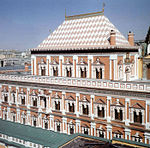
The Cathedral of the Savior of the Holy Face (Russian: Собо́р Спа́са Нерукотво́рного О́браза, tr. Sobor Spasa Nerukotvornogo Obraza), commonly known as Verkhospassky Cathedral (Russian: Верхоспасский собор), is an Orthodox church and the cathedral of the Grand Kremlin Palace. It was built from 1635 to 1636 by Bazhen Ogurtsov, Antip Konstantinov, Trefil Sharutin and Larion Ushakov. It is part of the complex of house churches of Russian tsars at the Terem Palace. The church is closed for free visits and services are not performed there.

Excerpt from the Wikipedia article Verkhospassky Cathedral (License: CC BY-SA 3.0, Authors, Images).

Verkhospassky Cathedral
Moscow Tverskoy District

Geographical coordinates (GPS) Address Nearby Places
placeShow on map

Wikipedia: Verkhospassky CathedralContinue reading on Wikipedia

Geographical coordinates (GPS)

Latitude Longitude
N 55.750555555556 ° E 37.616111111111 °
placeShow on map

Address

Большой Кремлёвский дворец


103073 Moscow, Tverskoy District
Moscow, Russia
mapOpen on Google Maps

Mosca Cremlino 21
Mosca Cremlino 21
Share experience

Nearby Places

Church of the Deposition of the Robe

The Church of the Deposition of the Robe (Russian: Церковь Ризоположения) is a church which stands on Cathedral Square in the Moscow Kremlin. It was begun in 1484 by masters from Pskov, most likely by the same group of architects who built the adjacent Cathedral of the Annunciation. It serves as a part of Moscow Kremlin Museums. The church was built on the site of a previous church, built by Jonah Metropolitan of Moscow in 1451. The name of the church, variously translated as the Church of the Virgin's Robe, The Church of Laying Our Lady’s Holy Robe, The Church of the Veil or simply Church of the Deposition, is said to refer to a festival dating from the 5th century AD, celebrating when the robe of the Virgin Mary was taken from Palestine to Constantinople, where it protected the city from being conquered. For example, tradition says that during the Rus'-Byzantine War of 860 the patriarch placed the Virgin's Robe into the sea, causing a storm that destroyed the invading Rus' ships. A four-level iconostasis, created by Nazary Istomin Savin in 1627, has been preserved in the church, and has frescoes painted by Ivan Borisov, Sidor Pospeev and Semyon Abramov in 1644. The church itself was built in the traditional Early Russian style, characterized by "a noticeable tendency towards more elevated proportions, the overall structure being extended by being placed on raised foundations, and the drum supporting the single dome also being raised." As with the Cathedral of the Annunciation, the intricate interior detail and ornamentation were characteristic of the Russian architecture of this period.Originally, the church served as the private chapel of the Patriarch of Moscow, but during the mid-17th century it was taken over by the Russian royal family. The church was badly damaged in a fire in 1737 (the same fire that cracked the Tsar Bell). Today, the church also houses a display of wood sculpture from the 14th to 19th century.

Terem Palace
Terem Palace

Terem Palace or Teremnoy Palace (Russian: Теремной дворец) is a historical building in the Moscow Kremlin, Russia, which used to be the main residence of the Russian czars in the 17th century. Its name is derived from the Greek word τερεμνον (i.e., "dwelling"). Currently, the structure is not accessible to the public, as it belongs to the official residence of the President of Russia. In the 16th century Aloisio da Milano constructed the first royal palace on the spot. Only the ground floor from that structure survives, as the first Romanov tsar, Mikhail Feodorovich, had the palace completely rebuilt in 1635–36. The new structure was surrounded by numerous annexes and outbuildings, including the Boyar Platform, Golden Staircase, Golden Porch, and several turrets. On Mikhail's behest, the adjoining Golden Tsaritsa's Chamber constructed back in the 1560s for Ivan IV's wife, was surmounted with 11 golden domes of the Upper Saviour Cathedral. The complex of the palace also incorporates several churches of earlier construction, including the Church of the Virgin's Nativity from the 1360s. The palace consists of five stories. The third story was occupied by the czarina and her children; the fourth one contained the private apartments of the czar. The upper story is a tent-like structure where the Boyar Duma convened. The exterior, exuberantly decorated with brick tracery and colored tiles, is brilliantly painted in red, yellow, and orange. The interior used to be painted as well, but the original murals were destroyed by successive fires, particularly the great fire of 1812. In 1837, the interiors were renovated in accordance with old drawings in the Russian Revival style.