place

Lake Seminole

1957 establishments in Florida1957 establishments in Georgia (U.S. state)ACF River BasinBodies of water of Decatur County, GeorgiaBodies of water of Seminole County, Georgia
Borders of FloridaBorders of Georgia (U.S. state)Lakes of Gadsden County, FloridaLakes of Jackson County, FloridaProtected areas of Decatur County, GeorgiaProtected areas of Gadsden County, FloridaProtected areas of Jackson County, FloridaProtected areas of Seminole County, GeorgiaReservoirs in FloridaReservoirs in Georgia (U.S. state)
USACE Jim Woodruff Lock and Dam

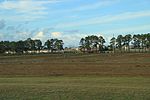
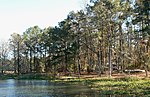
Lake Seminole is a reservoir located in the southwest corner of Georgia along its border with Florida, maintained by the U.S. Army Corps of Engineers. The Chattahoochee and Flint rivers join in the lake, before flowing from the Jim Woodruff Lock and Dam, which impounds the lake, as the Apalachicola River. The lake contains 37,500 acres (152 km2) of water, and has a shoreline of 376 mi (605 km). The fish in Lake Seminole include largemouth bass, crappie, chain pickerel, catfish, striped bass and other species. American alligators, snakes and various waterfowl are also present in the lake, which is known for its goose hunting.

Excerpt from the Wikipedia article Lake Seminole (License: CC BY-SA 3.0, Authors, Images).

Geographical coordinates (GPS)

Latitude Longitude
N 30.72 ° E -84.87 °
placeShow on map

Address

Jackson County (Jackson)


Florida, United States
mapOpen on Google Maps

USACE Jim Woodruff Lock and Dam
Share experience

Nearby Places

Nicolls' Outpost

Nicolls' Outpost was the smaller and more northern of two forts built by British Lt. Col. Edward Nicolls during the War of 1812. (The Americans referred to it as Fort Apalachicola. Built at the end of 1814, together with the larger "British post" or storage depot down the Apalachicola,: 47  it was "the northernmost post built by the British during their Gulf Coast Campaign". It was just below the Spanish Florida–Georgia border, where the Flint and Chattahoochee Rivers meet to form the Apalachicola, in River Landing Park in modern Chattahoochee, Florida. Even though what was built was smaller than the much larger British post down the Apalachicola, it was intended to be the base, presumably enlarged, for an English invasion of the United States, and British post was to have been its supply depot. The 1815 end of the War of 1812 aborted this project. It was built atop the largest of three surviving mounds of the prehistoric Fort Walton culture. Above the winter flood stage of the Apalachicola, it could reach both forks of the river with cannon fire. It was built in 1814 and abandoned early in 1815, at the end of the war. It was armed with a 5+1⁄2-inch howitzer. It also had a coehorn, a mortar that could fire 24-pound shells. According to a report of U.S. Colonel and Indian agent Benjamin Hawkins, there were "200 troops white and black and an assemblage of 500 [Creek] Warriors", "well supplied with cloth[e]s and munitions of War". The intention was to mount an expedition "up the river" (the Flint), bringing the cannon along.: 76  Georgia militia, other U.S. forces, and the faction of the Creek allied with the U.S. (the Lower Creeks) were preparing upriver (in Georgia) for a battle. News of the treaty ending the war (Treaty of Ghent), which reached both sides in February 1815, prevented the battle from taking place. The British abandoned both of its forts on the Apalachicola, leaving them in the hands of the black Corps of Colonial Marines that Nicolls had trained, and of Red Stick Creek Neamathla and his warriors.