place

Posteljooninpuisto

KyttäläParks in Tampere
Train stop at Tampere

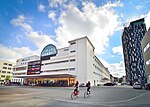
Posteljooninpuisto (Finnish for "Postman's Park") is a French formal garden style park built in the 1930s in central Tampere, Finland, at the corner of Rautatienkatu and Itsenäisyydenkatu. At the corner of the park is the former head post office of Tampere. The park is also internally connected to the Tampere railway station located next to it, which the Finnish Heritage Agency has classified as a significant cultural environment. The park is owned by the city of Tampere.The majority of the trees at Posteljooninpuisto are deciduous. Trees planted there include common lindens. All of the lawn areas, structures of walking paths and lights were renovated from 2017 to 2018. At the same time, a pool was built underneath the park, in order to prevent urban runoff water from draining to the tunnel underneath the railway.The steel sculpture Elämän virta ("Flow of life") designed by Aimo Taleva is located at the park. It is a memorial to the schlager and tango singer Olavi Virta, who lived his final years in Tampere.

Excerpt from the Wikipedia article Posteljooninpuisto (License: CC BY-SA 3.0, Authors, Images).

Posteljooninpuisto
Itsenäisyydenkatu, Tampere Kyttälä (Keskustan suuralue)

Geographical coordinates (GPS) Address Nearby Places
placeShow on map

Wikipedia: PosteljooninpuistoContinue reading on Wikipedia

Geographical coordinates (GPS)

Latitude Longitude
N 61.499166666667 ° E 23.772222222222 °
placeShow on map

Address

Elämän virta

Itsenäisyydenkatu
33100 Tampere, Kyttälä (Keskustan suuralue)
Finland
mapOpen on Google Maps

Train stop at Tampere
Share experience

Nearby Places

Tampere Central Station

Tampere Central Station is a functionalist building in Tampere, Finland, designed by Eero Seppälä and Otto Flodin, completed in 1936. The station is one of the most important railway stations in Finland. In 2015, the Tampere Central Station was the second busiest railway station in Finland in terms of numbers of passengers, after the Helsinki Central Station.The 36-metre clock tower was later added because the Finnish railway bureau required it (its total height from ground level is about 50 metres). The city's main street Hämeenkatu begins at the railway station, continuing over the Hämeensilta bridge to its western end at the Aleksanteri Church. The Itsenäisyydenkatu (originally called Puolimatkankatu) street begins at the Tammela side of the station, continuing to the Kaleva Church. Situated in a central location, the station and its railway yard have served as divisors of the city's districts almost in the same way as Tammerkoski: Tamperean places are often located by saying which side of the station they are on. For decades, there has been discussion of a unified travel centre in Tampere: currently, the long-distance bus terminal, the Tampere Bus Station, is quite far away from the railway station. There are currently three platforms in the Tampere railway station, two of which have a roof. There are five tracks in total, but there are plans to add a fourth platform, making seven tracks in total. The Tampere cargo station is located south from the passenger station. It includes one of the busiest railway organisation yards in Finland. The green building on the east side of the tracks, opposite the old passenger station is the old cargo station. A track leads from the cargo station, over the highway to Helsinki, to the Nekala district, which previously contained many private tracks servicing stock companies. Nowadays, some of the tracks have been disassembled and some are disused. The starting point of the track is used to store train carriages.