place

Estonian Health Care Museum

Health in EstoniaMuseums in Tallinn
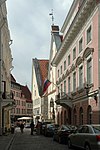
Esti Health Museum and St. Olaf's Church Esti Tervishoiu muuseumi ja Oleviste kirik panoramio

Estonian Health Care Museum (Estonian: Eesti Tervisemuuseum) is a health museum in Tallinn, Estonia. The museum collects, exhibits and analyzes things related to healthcare in Estonia.The museum was established in 1921. Its first exhibition, held from 1924 to 1928, had 300 exhibits borrowed from foreign museums. Before 1945, the museum was located in Tartu. In 1932, the branch was opened in Tallinn. In 1945, the museum was re-organized into the educational sanitary house (Estonian: sanitaarharidusmaja). In 1950, the sanitary house was closed.During the Soviet occupation of Estonia, the museum was closed and many of its items destroyed. The museum re-opened in 1980 in Tallinn as the Health Museum of the Centre of Sanitary Education of the Republic. In 1989, the museum changed its name back to the Estonian Health Care Museum when it reorganized as an independent entity.

Excerpt from the Wikipedia article Estonian Health Care Museum (License: CC BY-SA 3.0, Authors, Images).

Estonian Health Care Museum
Lai, Tallinn Kesklinna linnaosa

Geographical coordinates (GPS) Address Nearby Places
placeShow on map

Wikipedia: Estonian Health Care MuseumContinue reading on Wikipedia

Geographical coordinates (GPS)

Latitude Longitude
N 59.43955 ° E 24.74542 °
placeShow on map

Address

Lai 30
10133 Tallinn, Kesklinna linnaosa
Estonia
mapOpen on Google Maps

Esti Health Museum and St. Olaf's Church Esti Tervishoiu muuseumi ja Oleviste kirik panoramio
Share experience

Nearby Places

House of the Blackheads (Tallinn)

House of the Blackheads (Estonian: Mustpeade maja), or House of the Brotherhood of Black Heads, in Tallinn, the capital of Estonia, is a former headquarters of the Brotherhood of Blackheads. Historically this was a professional association of ship owners, merchants and foreigners dating from the 14th century. They were active in Livonia (present-day Estonia and Latvia) but fled to Germany during the Soviet occupation of the Baltic States in 1940. The House of the Blackheads was visited by several Russian Emperors including Peter I, Paul I and Alexander I who also became honorable members the Brotherhood.The building was acquired by this organization in 1517. In 1597 it was renovated under supervision of the architect Arent Passer. The façade was rebuilt in the style of Renaissance architecture from the Low Countries. The painted doors date from the 1640s. A Maure, a symbol of Saint Maurice, the patron saint of the Brotherhood, appears both carved in wood and sculpted in stone above the door. The House of the Brotherhood of Black Heads today comprises three separate buildings, and has four halls and several other rooms which are used for a variety of events. The White Hall was built in 1531-32, but was remodelled during reconstruction work between 1909 and 1911. St. Olaf’s Guild Hall, whose interior architecture comes from the early 15th century, was purchased by the Blackheads in 1919 and was remodeled between 1919 and 1922.