place

Church of the Holy Spirit, Tallinn

13th-century churches in Estonia13th-century establishments in EstoniaChurches in TallinnGothic architecture in EstoniaKesklinn, Tallinn
Lutheran churches in Estonia
Tallinna Pühavaimu kirik1

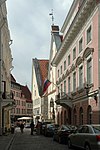
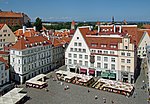
The Church of the Holy Ghost or Church of the Holy Spirit (Estonian: Püha Vaimu kirik, , German: Heiliggeistkirche ) is a medieval Lutheran church in the old town district of Tallinn, Estonia. It is located behind Raekoja plats, and lies opposite the Great Guild and Maiasmokk, Tallinn's oldest café.

Excerpt from the Wikipedia article Church of the Holy Spirit, Tallinn (License: CC BY-SA 3.0, Authors, Images).

Church of the Holy Spirit, Tallinn
Pühavaimu, Tallinn Kesklinna linnaosa

Geographical coordinates (GPS) Address External links Nearby Places
placeShow on map

Wikipedia: Church of the Holy Spirit, TallinnContinue reading on Wikipedia

Geographical coordinates (GPS)

Latitude Longitude
N 59.438055555556 ° E 24.745833333333 °
placeShow on map

Address

Pühavaimu kirik

Pühavaimu 2
10123 Tallinn, Kesklinna linnaosa
Estonia
mapOpen on Google Maps

linkWikiData (Q777726)
linkOpenStreetMap (28131871)

Tallinna Pühavaimu kirik1
Share experience

Nearby Places

Tallinn
Tallinn

Tallinn (; Estonian: [ˈtɑlʲːinː]) is the most populous, primate, and capital city of Estonia. Situated on a bay in north Estonia, on the shore of the Gulf of Finland of the Baltic Sea, Tallinn has a population of 446,396 (as of 2022) and administratively lies in the Harju maakond (county). Tallinn is the main financial, industrial, and cultural centre of Estonia. It is located 187 km (116 mi) northwest of the country's second largest city Tartu, however only 80 km (50 mi) south of Helsinki, Finland, also 320 km (200 mi) west of Saint Petersburg, Russia, 300 km (190 mi) north of Riga, Latvia, and 380 km (240 mi) east of Stockholm, Sweden. From the 13th century until the first half of the 20th century, Tallinn was known in most of the world by variants of its other historical name Reval. Tallinn received Lübeck city rights in 1248, however the earliest evidence of human population in the area dates back nearly 5,000 years. The first recorded claim over the place was laid by Denmark after a successful raid in 1219 led by king Valdemar II, followed by a period of alternating Scandinavian and Teutonic rulers. Due to the strategic location by the sea, its medieval port became a significant trade hub, especially in the 14–16th centuries, when Tallinn grew in importance as the northernmost member city of the Hanseatic League. Tallinn's Vanalinn ("Old Town") is one of the best-preserved medieval cities in Europe and is listed as a UNESCO World Heritage Site.Tallinn has the highest number of start-ups per person among European countries and is the birthplace of many international high-technology companies, including Skype and Wise. The city is home to the headquarters of the European Union's IT agency, and to the NATO Cyber Defence Centre of Excellence. In 2007, Tallinn was listed among the top-10 digital cities in the world.